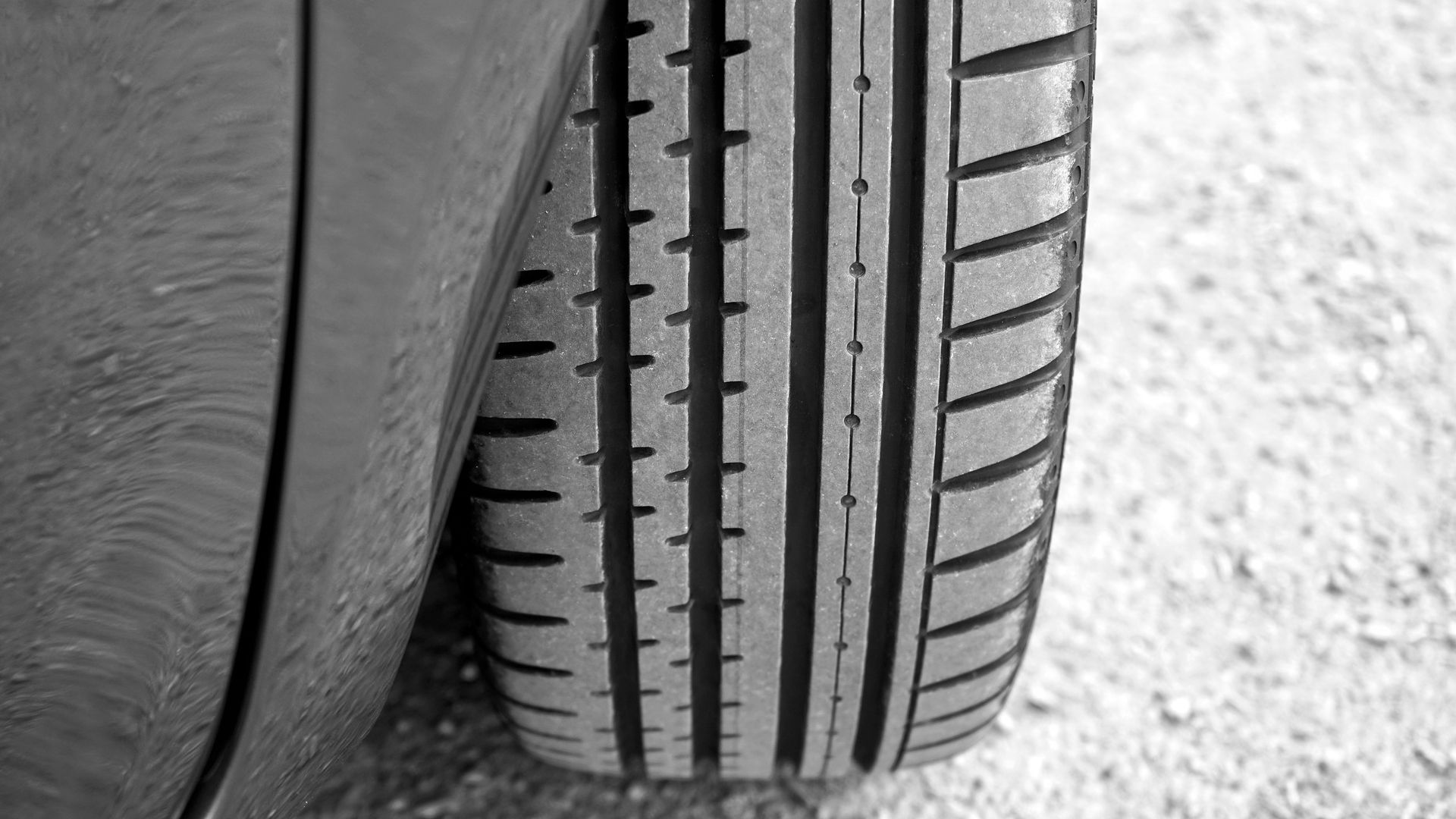
A truck tire on gravel. Photo by Mike Bird via Pexels.
The first cold mornings of fall are when tire pressure warning lights come on across the country, and many go off again by lunchtime. Most of the time there is no puncture. The air in the tire has shrunk with the temperature, and a tire that was a little low to begin with has dropped below the warning threshold.
Pressure follows temperature
A General Motors service bulletin on tire pressure, filed with NHTSA, gives the rule of thumb: a temperature change of about 10°F changes tire pressure by about 1 psi. By that rule, a tire set on a 75-degree afternoon will read about 4 psi lower on a 35-degree morning without losing any air.
What the warning light is built to catch
Federal safety standard 138 requires the warning to come on within 20 minutes once a tire falls to 25 percent below the manufacturer’s recommended cold pressure, or to a minimum set in the standard for that tire type, whichever is higher. NHTSA says the systems have been required on passenger cars, light trucks and vans since the 2008 model year.
That threshold is not the correct pressure. It is the point at which a tire is significantly underinflated. NHTSA says the light is no substitute for checking pressure with a gauge at least once a month.
Why the light comes on and then goes off
NHTSA explains the on-again, off-again light directly. On cold mornings, a tire with marginally low pressure can dip below the threshold overnight, then rise above it as driving or the afternoon warms the tire. NHTSA’s advice when that happens is to inspect the tires and check the pressure.
GM’s bulletin adds that if the light goes off after the tires warm up, the pressure should be reset to the placard figure at the cold temperature. Topping up only to stop a warning leaves the tire low all winter.
Cold means parked, not chilly
The recommended figure is a cold pressure, and cold has a specific meaning. NHTSA defines it as a tire that has not been driven for at least three hours. GM’s bulletin also counts a tire driven no more than a mile. A reading taken after a highway drive will be higher than the cold figure, so NHTSA says to measure cold or account for the extra pressure in a warm tire.
The right number is on the door
The recommended pressure is on the tire and loading information label on the driver’s door edge, or in the owner’s manual, according to NHTSA. GM’s bulletin stresses that it is not the pressure printed on the sidewall, which is a maximum for the tire, not a setting for your truck.
That label sits beside the weight ratings explained in our piece on the sticker in your door jamb. What the sidewall does tell you is covered in how to read a tire sidewall.
A flashing light means something else
A light that flashes for 60 to 90 seconds at start-up and then stays on is not a pressure warning. NHTSA says that sequence signals a fault in the monitoring system itself, and it will repeat at every start until it is repaired.
Heavy trucks and duallies
Standard 138 applies to vehicles with a gross vehicle weight rating of 10,000 pounds or less, and it excludes vehicles with dual wheels on an axle. Owners of heavy-duty pickups above that rating, or of dual-rear-wheel trucks, should check the owner’s manual to see whether the truck has a system at all, and keep a gauge in the glovebox either way.
The same goes after a day on the trail. Tires aired down for traction need to go back to the placard figure before highway speed.
Sources
- General Motors, via NHTSA, Service Bulletin 00-00-90-002M: Information on Proper Tire Pressure (PDF)
- NHTSA, Tires
- eCFR, 49 CFR 571.138, Standard No. 138: Tire pressure monitoring systems
This article was researched and drafted with the assistance of AI tools and reviewed, fact-checked and edited by Leonidas Clark before publication. Figures vary by vehicle and configuration; confirm against your own door sticker and owner’s manual.