Explainer
Sand punishes the instincts developed on rock and mud. The vehicle behaves differently, and the errors are different too.
Flotation over grip
On sand you are not looking for traction against a solid surface — you are trying not to sink into a loose one. That makes contact area the governing variable.
This is where airing down matters most. Sand driving frequently uses lower pressures than any other terrain, precisely to spread weight.
Momentum, not torque
Stopping on soft sand is what strands vehicles. A stationary vehicle settles, and the tyres must then climb out of the depressions they have made.
So the technique is steady momentum, gentle throttle inputs, and reading ahead far enough that you never need to stop where you cannot restart.
Aggressive throttle digs. If wheels start spinning, backing off is nearly always right — which is the opposite of the instinct.
Turning and cresting
Sharp turns build a wall of sand in front of the tyres and can stop a vehicle dead. Wide, gradual arcs work.
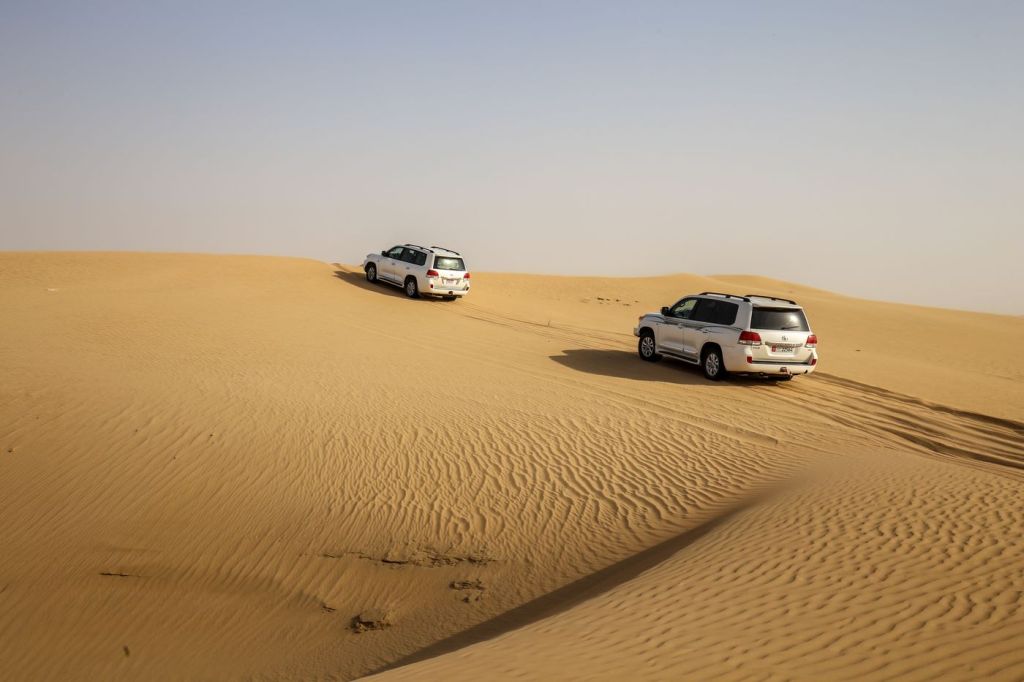
Cresting a dune is the classic serious hazard. Approach at an angle you can see over, and never crest at speed — what is on the far side may be a vertical drop, another vehicle, or a slope far steeper than the one you climbed.
The standard practice of a tall flag on a whip exists because vehicles are invisible to each other on the far side of a dune.
Heat and recovery
Sand loads the drivetrain continuously. Transmission and engine temperatures climb, and there is no coasting to recover.
Recovery in sand usually means digging and reducing pressure further rather than pulling — a winch needs an anchor, and dunes have none. Traction boards and a shovel do more work here than any recovery rope.
This article was researched and drafted with the assistance of AI tools and reviewed, fact-checked and edited by Leonidas Clark before publication. Off-road travel carries real risk; conditions and rules vary and you are responsible for your own judgement.
 The 4x4 Life
Leave a comment