Explainer
Hearing damage is the most common lasting injury associated with shooting, it is entirely preventable, and it does not heal.
The numbers
NIOSH sets the exposure limit for peak impulsive noise at 140 decibels, and treats a single event at that level as 100 percent of a person’s allowable daily noise exposure. Sustained noise above roughly 85 decibels causes cumulative damage over time.
Gunfire sits well above that threshold. NIOSH measurements put peak sound pressure levels at roughly 144 decibels for a .22 rifle and as high as 172 decibels for a .357 revolver, with law enforcement range exposures commonly reaching 160 to 170 decibels.
Because the decibel scale is logarithmic, the gap between 140 and 160 is not a modest increase — it is roughly a hundredfold in sound intensity. Peak level is not the only factor either: NIOSH notes that the number of impulses, and reverberation indoors, both affect the resulting damage.
What is actually damaged
Hair cells in the cochlea convert vibration into nerve signals. They do not regenerate in humans.
The result is permanent threshold shift, usually beginning in the higher frequencies — which is why early hearing loss shows up as difficulty separating speech from background noise rather than as everything being quieter.
Tinnitus, a persistent ringing, frequently accompanies it and has no cure.
What the ratings mean
The Noise Reduction Rating on hearing protection is a laboratory figure obtained under ideal fitting conditions, and real-world attenuation is typically lower, because fit in practice is worse than fit in a lab. Derating the number rather than trusting it is the conservative approach.
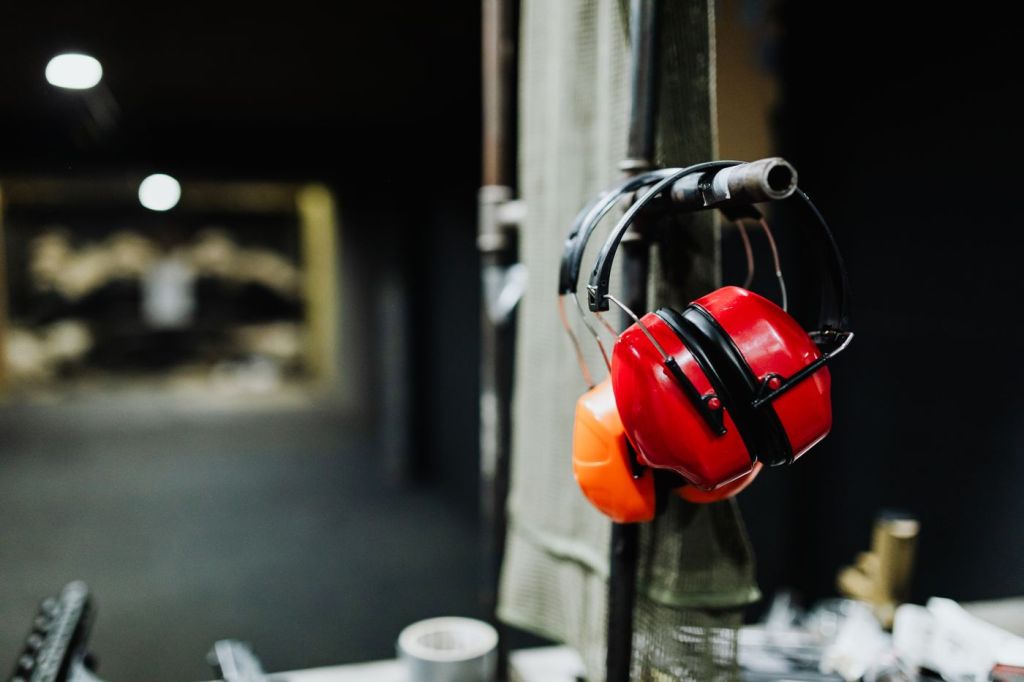
Earmuffs are defeated by anything breaking the seal: glasses arms, hair, a hat brim, the stock of a rifle pushing the cup off the head. That last one is why rifle shooters often prefer plugs or slim-profile muffs.
Plugs work well but only when inserted properly — rolled down, inserted deep, and held while they expand. A plug sitting at the entrance of the canal does very little.
Doubling up
Wearing plugs under muffs does not add the two ratings together, but it does add meaningfully, and NIOSH recommends exactly this combination — earplug plus earmuff — to keep peak exposure below the 140 decibel limit at a firing range.
It is standard practice indoors and next to muzzle brakes, which redirect gas sideways and substantially increase the noise reaching people beside the shooter.
Hunting
This is where protection is most often skipped, on the reasoning that it is one shot and you need to hear.
One shot is enough. Electronic muffs and in-ear electronic plugs amplify quiet sound and compress the shot, which solves the actual objection.
Sources
- NIOSH, Hit the Mark: Firearms training without damaging your hearing — peak levels of 160–170 dB at ranges; NIOSH Science Bulletin
- NIOSH, How Can We Measure Impulse Noise Properly? — the 140 dB peak exposure limit
- NIOSH, Noise and Hearing Loss Prevention
This article was researched and drafted with the assistance of AI tools and reviewed, fact-checked and edited by Leonidas Clark before publication. It is general information, not legal advice. Firearm law varies by state and changes; verify before relying on it.
 The 4x4 Life
Leave a comment