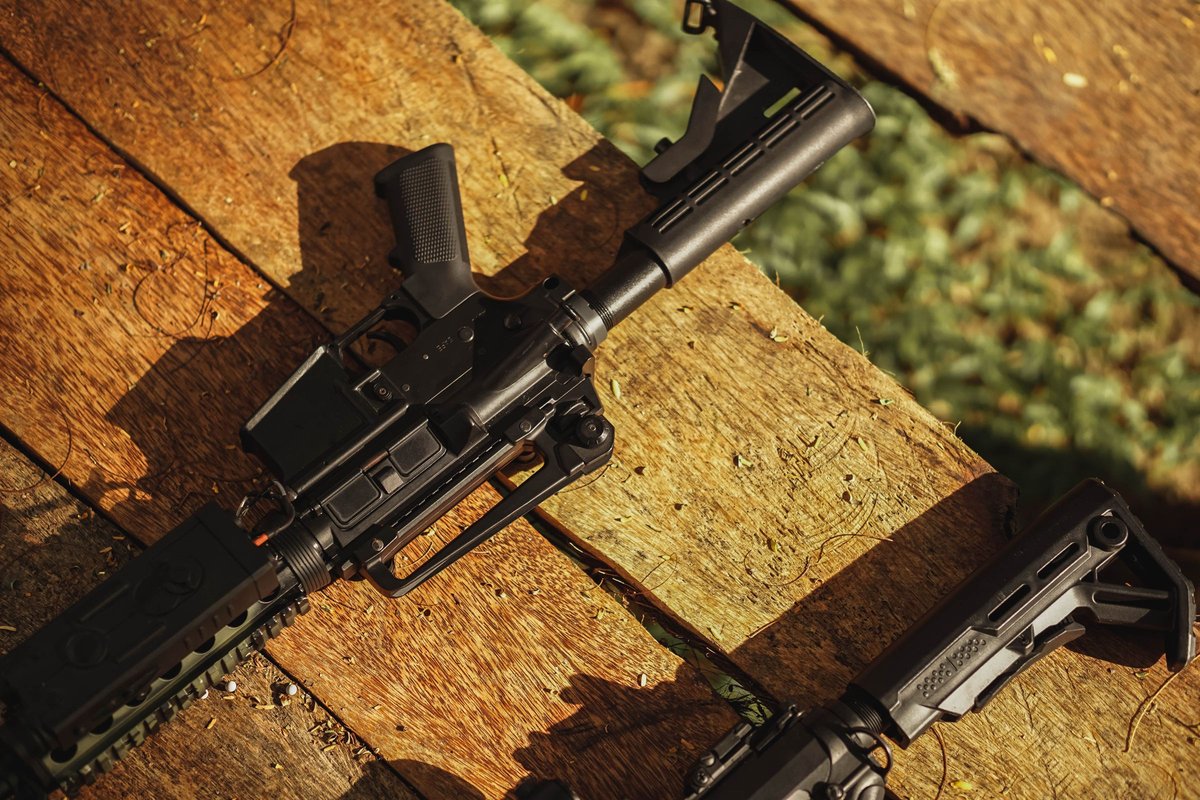
An AR-style rifle on wooden planks. Photo by ARMAN ALCORDO JR. via Pexels.
Federal agents stopped enforcing National Firearms Act registration for short-barreled rifles and shotguns on October 9. In Maryland that changes nothing, because state law allows those guns only if they are registered with the federal government. On October 15, Maryland State Police said the requirement stands.
What Maryland law says
Under Maryland Public Safety Article § 5-203, a person may not possess a short-barreled rifle or short-barreled shotgun unless it has been registered with the federal government in accordance with federal law. The only other exceptions cover people on official business, such as law enforcement officers and on-duty members of the armed forces or National Guard.
Two more details make the rule stricter than it first looks. In a prosecution, the defendant has to prove the gun was lawfully registered. A violation is a misdemeanor, but it carries up to five years in prison, a fine of up to $5,000, or both.
What the state police said
In a public statement released October 15 and published by the news site The BayNet, Maryland State Police said the ATF open letter does not change Maryland’s requirements for NFA firearms. Anyone making, acquiring or transferring a short-barreled rifle or shotgun in the state must still submit the appropriate ATF application, a Form 1 to make one or a Form 4 to transfer one. ATF must approve it before the federal Form 4473 and Maryland’s 77R process are completed.
Maryland is not unusual in this. The Associated Press, in its report on the federal change, said registration still applies for buyers in about 15 states whose laws require people to go through the federal process.
Why federal non-enforcement does not reach it
ATF itself says its policy does not override state or local law. In its guidance, the agency notes that most states either require NFA items to comply with federal law or be registered under it, and that it cannot say whether an unregistered item held under its new policy counts as lawfully registered for state purposes. Maryland has answered that question for its own statute.
Dealers have a federal reason to follow the state answer. The Gun Control Act bars licensed dealers from selling or delivering any firearm in violation of state or local law. ATF warns that a dealer who does so willfully faces federal criminal penalties and license revocation.
Registration is still available
Because many state laws depend on federal registration, ATF says it will keep processing NFA applications from anyone who submits them. For Maryland residents that is the path the state police describe. ATF also warns that an item removed from the federal registry cannot be re-registered unless the attorney general declares an amnesty, a point for owners who might consider unregistering.
Driving through, not only living there
The question matters to hunters crossing Maryland as well as to those who live there. ATF says it is unclear whether state courts will apply the federal safe-passage provision, 18 U.S.C. 926A, to unregistered NFA items. It advises caution before driving through any state where such items are prohibited, even when the starting and ending states allow them.
Separately, federal law still requires a Form 20 before taking a short-barreled rifle or shotgun across state lines, whether or not it is registered. We set out the general travel rules in transporting firearms across state lines.
The pattern to check in your own state
ATF describes three broad groups of states. Many have no state controls on some items, such as suppressors. Most tie legality to federal compliance or registration, as Maryland does. A minority prohibit most or all NFA items outright. Which group a state falls into decides whether the federal change matters there at all. The same layering applies to hunting with these items, as covered in suppressors for hunting.
The federal background check at the counter is unaffected everywhere. Our explainer on what a background check checks covers that step.
Sources
- Maryland State Police (statement published by The BayNet), Maryland Gun Owners Still Face State Requirements Despite Updated Federal NFA Guidance
- Associated Press (via WBAL), Justice Department won’t enforce registration rules on silencers and certain guns after court ruling
- Maryland General Assembly, Public Safety Article § 5-203
- ATF, Update to NFA Transfer Guidance (open letter and FAQ)
- ATF, ATF issues guidance on National Firearms Act transfers for short-barreled rifles, short-barreled shotguns, suppressors, and certain other firearms
- Legal Information Institute, 18 U.S. Code § 922, Unlawful acts
- Legal Information Institute, 18 U.S. Code § 926A, Interstate transportation of firearms
This article was researched and drafted with the assistance of AI tools and reviewed, fact-checked and edited by Leonidas Clark before publication. It is general information, not legal advice. State law varies and changes; confirm with state authorities or an attorney before you buy, make or travel with a regulated firearm.