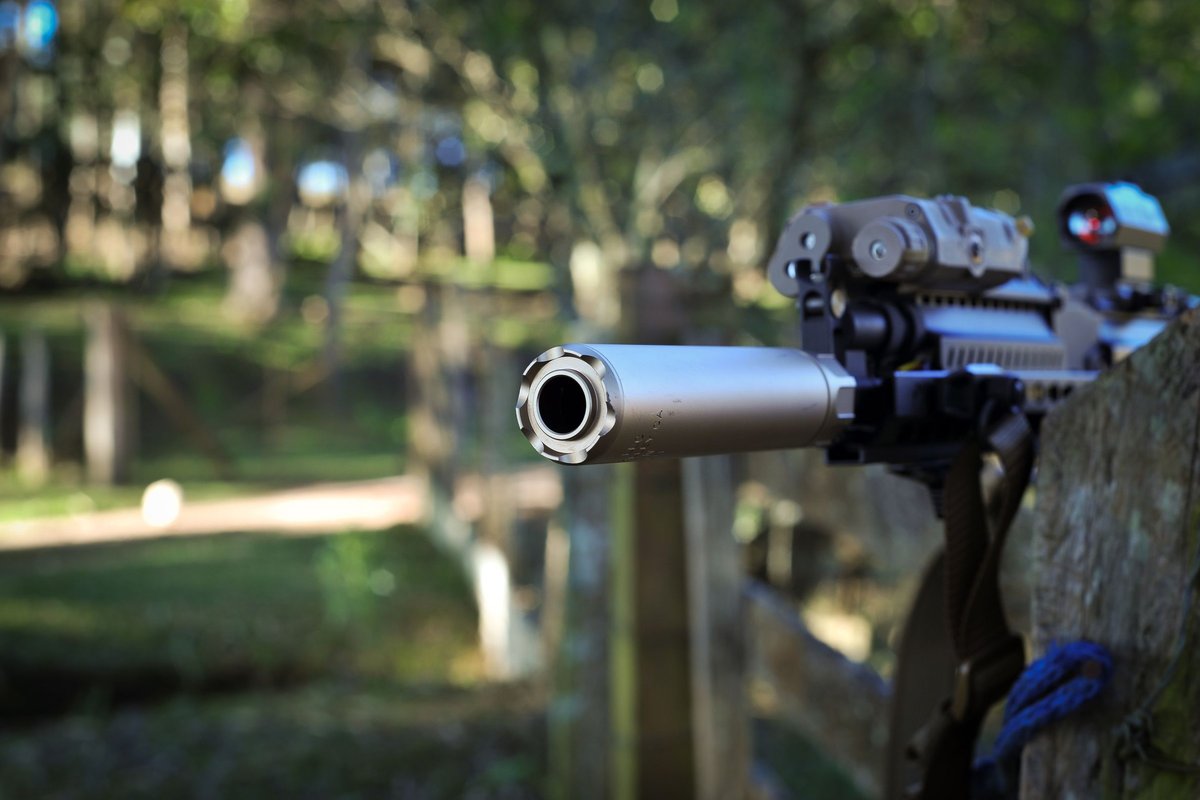
A rifle fitted with a suppressor. Photo by Dan Galvani Sommavilla via Pexels.
Since October 9, buying a suppressor or a short-barreled rifle no longer requires federal approval, a registration or a tax stamp. That is the biggest change to these purchases in decades, but it is narrower than it sounds. The background check, the rest of federal gun law and every state law that touches these items are untouched.
What changed on October 9
In an open letter and a set of frequently asked questions, ATF said it will no longer enforce the National Firearms Act requirements to apply for and receive approval before making or transferring four kinds of items: short-barreled rifles, short-barreled shotguns, suppressors and the category the law calls “any other weapons.” It also stopped enforcing registration in the National Firearms Registration and Transfer Record, the NFA marking requirement and the ban on carrying unregistered NFA items across state lines.
The policy applies to everyone, not only to the parties in the lawsuit that prompted it.
Why it happened
The One Big Beautiful Bill Act cut the NFA’s making and transfer taxes on those four categories to $0. On August 5, a federal judge in the Northern District of Texas ruled in Silencer Shop Foundation v. ATF that the registration and transfer provisions were no longer a valid use of Congress’s taxing power for those items, and barred ATF from enforcing them against the plaintiffs. The Justice Department then chose not to enforce them against anyone, which ATF says is meant to remove the uneven situation the limited injunction created.
What did not change
Machine guns and destructive devices still carry the $200 tax, and every NFA provision still applies to them. Businesses that make, import or deal in NFA items still owe the special occupational tax.
The four affected items also remain “firearms” under the Gun Control Act. Prohibited persons still cannot possess them. A licensed dealer still completes a Form 4473 and runs a NICS check before handing one over, as covered in our explainer on what a background check checks. An unlicensed person still may not transfer one to a resident of another state.
Short-barreled rifles carry an extra step
The Gun Control Act has its own rules for short-barreled rifles and shotguns that the court did not touch. Under 18 U.S.C. 922(a)(4), a person moving one across state lines still needs ATF approval, which ATF says means filing a Form 20 even if the gun is not registered. Dealers face a separate approval requirement for selling them. ATF says no process for that exists outside the NFA yet, so it will not enforce that provision until it writes one.
State law is now the real limit
ATF is blunt that its policy does not override state or local law. It says most states either ban NFA items outright or allow them only when they comply with or are registered under federal law, and that it cannot say whether an unregistered item will count as lawful for state purposes. Dealers remain barred from selling anything in violation of state or local law.
The Associated Press, in its report on the policy, said registration still applies for buyers in about 15 states whose laws require people to go through the federal process. Maryland’s statute works that way. In a public statement on October 15, Maryland State Police said the state’s requirements are unchanged and that short-barreled rifles and shotguns still need an approved ATF Form 1 or Form 4. Hunting rules add a separate layer again. New York, for example, prohibits hunting big game with any firearm equipped with a silencer. We set out how those layers stack in suppressors for hunting.
The risk ATF spells out
ATF lists ways enforcement could resume: Congress could impose a new tax, the injunction could be overturned or dissolved, or the department could rescind the policy. The NFA treats unregistered items as contraband carrying felony penalties, and ATF says federal law does not generally allow registration after the fact or automatic grandfathering. The attorney general may hold an amnesty of up to 90 days but is not required to.
ATF will keep accepting registrations from anyone who wants one. It also warns that an item removed from the registry cannot be re-registered unless an amnesty is declared.
Driving to a hunt
ATF says it is unclear whether state courts will apply the federal safe-passage provision in 18 U.S.C. 926A to unregistered NFA items. It advises caution before driving through a state that bans them, even when both the starting and ending states allow them. That is the same route-by-route check described in our guide to transporting firearms across state lines.
Sources
- ATF, Update to NFA Transfer Guidance (open letter and FAQ)
- ATF, ATF issues guidance on National Firearms Act transfers for short-barreled rifles, short-barreled shotguns, suppressors, and certain other firearms
- Maryland State Police (statement published by The BayNet), Maryland Gun Owners Still Face State Requirements Despite Updated Federal NFA Guidance
- Associated Press (via WBAL), Justice Department won’t enforce registration rules on silencers and certain guns after court ruling
- Legal Information Institute, 18 U.S. Code § 922, Unlawful acts
- Legal Information Institute, 18 U.S. Code § 926A, Interstate transportation of firearms
- Legal Information Institute, 26 U.S. Code § 5845, Definitions
- New York State DEC, Deer and Bear Hunting Regulations
This article was researched and drafted with the assistance of AI tools and reviewed, fact-checked and edited by Leonidas Clark before publication. This is general information about federal law, not legal advice. State law varies and changes; confirm before you buy, make or travel with any of these items.