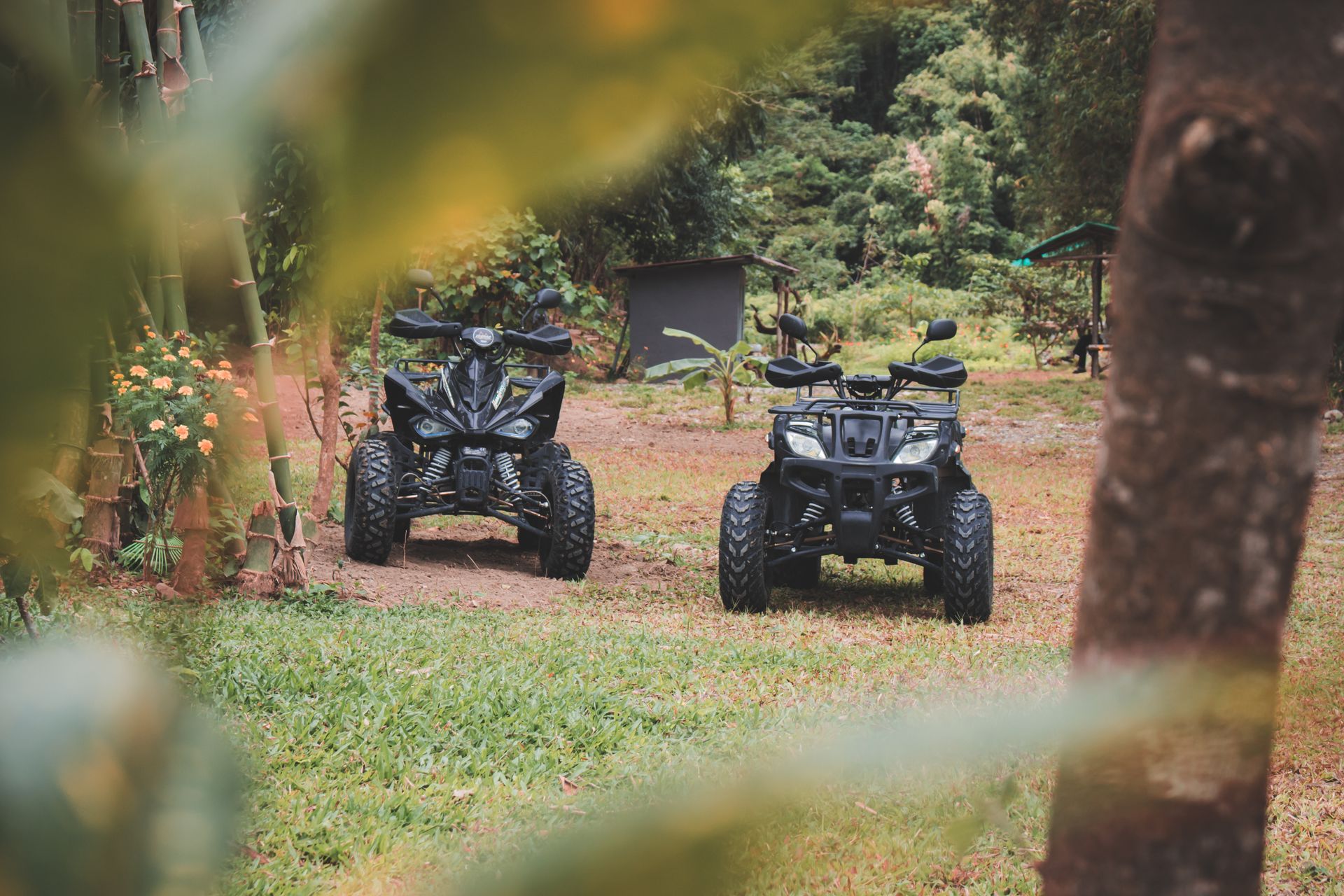
Two ATVs parked in a forest. Photo by king caplis via Pexels.
Fall puts ATVs to work in hunting camps and on farms, and that is when a second rider climbs on behind or a child takes a turn on the adult machine. Both are common, and federal safety guidance and the industry’s own training body advise against both.
The scale of the problem
The Consumer Product Safety Commission reports an annual average of more than 800 deaths and about 100,000 emergency room injuries involving off-highway vehicles. Its 2024 report attributes 1,728 of the 2,577 off-highway vehicle deaths from 2019 through 2021 to ATVs. Of all 2,577, 342 were children under 16, and 137 were under 12.
What designed for one rider means
CPSC says most ATVs are designed for one rider and advises never carrying more passengers than there are seats. The ATV Safety Institute, the industry’s training body, puts it as a golden rule: never carry a passenger on a single-rider ATV, and no more than one on a machine built for two.
The length of the seat does not change that. The institute also notes that ATVs handle differently from cars, motorcycles and side-by-sides.
What the passenger study found
A CPSC pilot study reviewed 502 fatal ATV incidents from 2005 to 2007 that involved more than one rider. In the most common case, a driver and one passenger, the driver was more often the one killed. When the passenger was not on the seat, was held on the driver’s lap or sat in front of the driver, the passenger was more likely to be the one who died.
With three or more riders, a passenger was killed in 67.4 percent of incidents. Overturns were the leading hazard regardless of how many people were aboard.
The study is careful about its limits. Staff could not conclude that leaving the passenger off would have prevented a death, and without data on how often people ride double, it could not calculate a risk rate. The rule against passengers rests on how the machines are designed, not on this study alone.
Adult machines and riders under 16
CPSC says riders younger than 16 should drive only age-appropriate youth models, never adult ones. The ATV Safety Institute explains the categories: two adult types, sport and utility, and three youth categories with smaller controls and lower speeds. Adult ATVs, meant for riders 16 and older, are larger, heavier and faster.
Every ATV made by the institute’s members carries a warning label stating the minimum rider age, placed where the rider can read it from the seat. Youth machines have their own problems when they do not meet the federal standard, as in the youth ATV recall we covered in July.
Pavement and public roads
CPSC advises staying off paved roads except to cross where the law allows. The institute adds that ATVs are designed for off-highway use and that another vehicle could hit you. Registration and road-crossing rules vary by state; see our OHV registration explainer.
The rest of the list
The remaining advice from both groups is consistent:
- Get hands-on training from a qualified instructor.
- Wear a helmet, eye protection, boots, gloves, long pants and long sleeves.
- Do not ride after drinking.
- Supervise riders younger than 16.
Sources
- U.S. Consumer Product Safety Commission, OHV and ATV Safety
- U.S. Consumer Product Safety Commission, 2024 Report of Deaths and Injuries Involving Off-Highway Vehicles with More than Two Wheels (PDF)
- U.S. Consumer Product Safety Commission, A Pilot Study of Fatal ATV-Related Incidents Involving Passengers (PDF)
- ATV Safety Institute, The Golden Rules
- ATV Safety Institute, One Size Doesn’t Fit All
This article was researched and drafted with the assistance of AI tools and reviewed, fact-checked and edited by Leonidas Clark before publication. Rules vary by state and land manager; confirm before you ride.