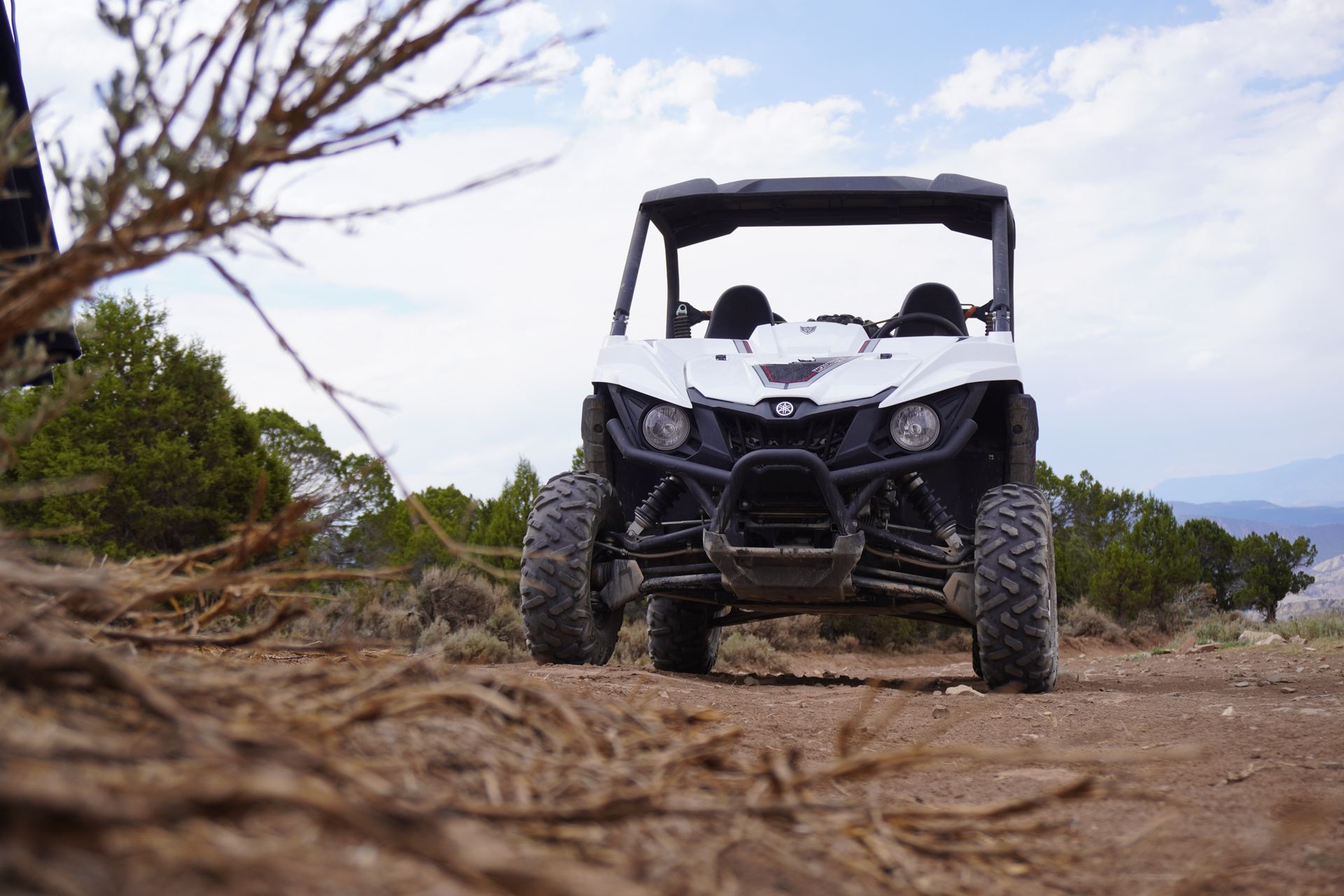
A utility vehicle on rough ground. Photo by moishy via Pexels.
Side-by-sides come with a roll cage and seat belts, which leads some riders to treat a tip-over as something the machine will absorb. Federal safety staff who reviewed side-by-side deaths found a consistent pattern. The vehicle rolls, a person is thrown partly or fully out of it, and the vehicle lands on them.
What makes a side-by-side different
The Consumer Product Safety Commission uses the term recreational off-highway vehicle, or ROV. Its standards page defines one by a steering wheel, bench or bucket seats, foot controls, a rollover protective structure, restraints, and a top speed above 30 mph. CPSC’s 2024 report on off-highway vehicle deaths lists the restraints as seat belts plus doors, nets and shoulder barriers.
The pattern CPSC found
CPSC staff reviewed 329 reports of ROV incidents from 2003 to 2010, involving 169 deaths and 299 injuries. A significant share involved a quarter-turn rollover onto the vehicle’s side, full or partial ejection of the occupant, and crushing of the head or body by the vehicle.
Belt use was poor where it could be determined. At least 42 percent of occupants were not wearing a seat belt, and belt use was unknown for another 42 percent. At least 53 percent were not wearing a helmet.
More recent numbers
CPSC’s 2024 report counts 2,577 deaths involving off-highway vehicles from 2019 through 2021. It attributes 651 to ROVs, 57 to slower utility vehicles and 141 to one or the other. Overturns and collisions were the most common hazards, and occupants were frequently ejected.
A follow-up study of 2023 emergency room cases found the vehicle had overturned in 63 percent of injuries, and the victim was ejected in 78 percent. That study covered all off-highway vehicles, not side-by-sides alone.
Why the belt matters more than the cage
A rollover structure protects the space inside it. A person outside that space, or with an arm or leg out of it, is in the path of the frame as the vehicle goes over, which is the pattern CPSC found. CPSC’s rider guidance is to always fasten seat belts and keep all parts of the body inside the vehicle.
Nets, doors and shoulder barriers exist for the same reason. CPSC describes them as meant to restrict occupants from leaving or reaching outside the vehicle during a rollover.
Barriers and the standards fight
Industry groups have proposed voluntary standards that add leg, shoulder, hip and arm barriers to keep occupants inside during a rollover, along with visual seat belt reminders. CPSC staff told the groups in 2011 that the proposed revisions did not adequately address stability, handling and occupant protection.
Seats, passengers and pavement
CPSC’s guidance for riders:
- Never carry more passengers than there are seat belts, and never carry anyone in the cargo bed.
- Do not carry a passenger who cannot sit back in the seat with both feet flat on the floorboard.
- Everyone on board should wear a helmet, eye protection, boots, gloves, long pants and long sleeves.
- Do not drive on paved roads, and check state laws before riding.
Some states now allow side-by-sides on public roads, as we covered in our piece on South Carolina’s new road rules. A state permitting it does not change CPSC’s safety advice. For registration rules where you ride, see our OHV registration explainer.
Sources
- U.S. Consumer Product Safety Commission, Recreational Off-Highway Vehicles (voluntary standards)
- U.S. Consumer Product Safety Commission, ROV Safety Information Center
- U.S. Consumer Product Safety Commission, 2024 Report of Deaths and Injuries Involving Off-Highway Vehicles with More than Two Wheels (PDF)
This article was researched and drafted with the assistance of AI tools and reviewed, fact-checked and edited by Leonidas Clark before publication. Off-road travel carries real risk; you are responsible for your own preparation and judgment.