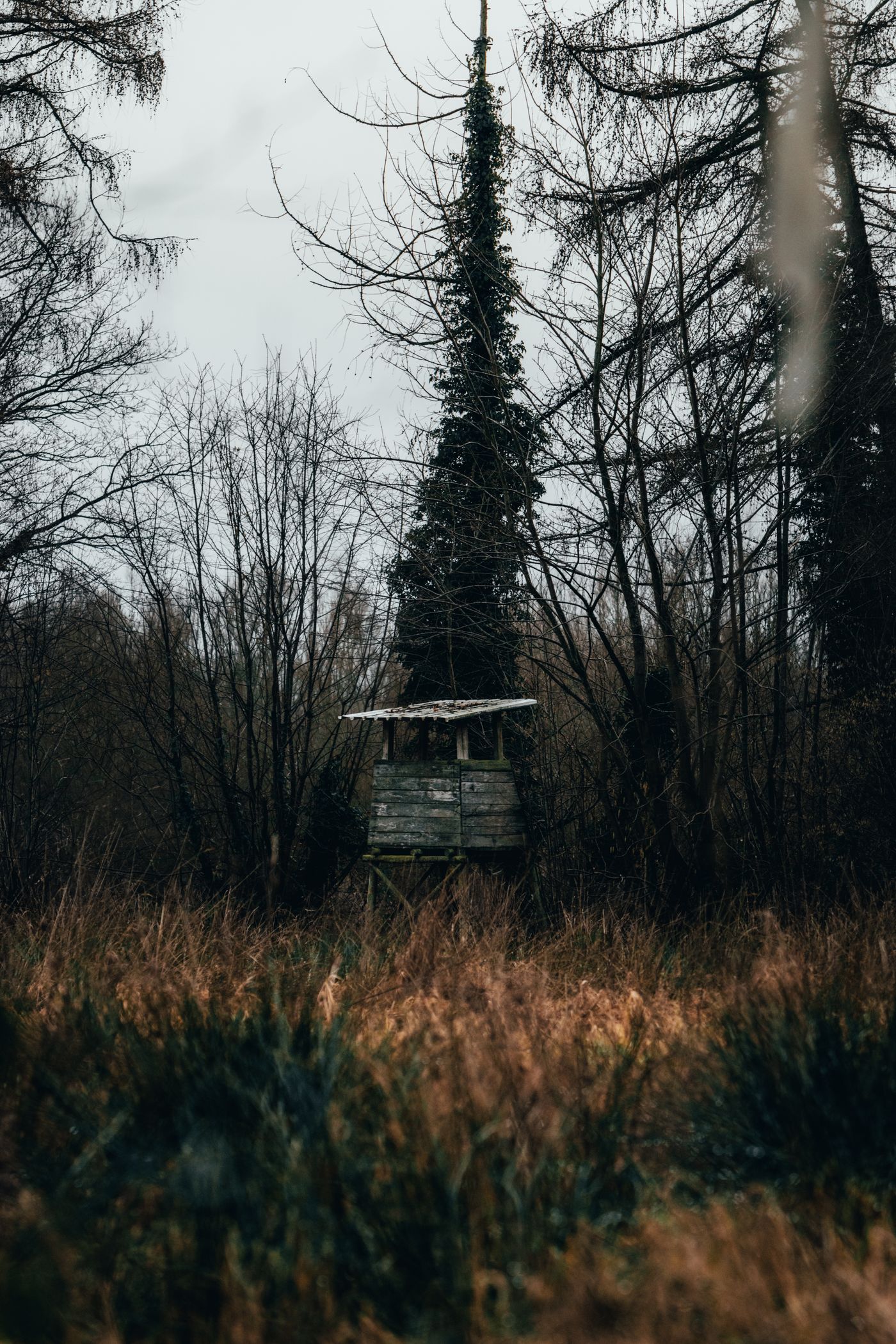
An elevated wooden hunting stand among bare trees in winter. Photo via Pexels.
Studies by state wildlife agencies and trauma centers repeatedly find that falls from elevated stands account for more serious hunting injuries than firearm incidents. A national review counted an estimated 38,308 emergency department visits for hunting stand injuries between 2008 and 2013, 80 percent of them falls, with one in five patients admitted to hospital. In Pennsylvania, treestand falls have become the leading cause of deer hunting accidents.
When falls happen
Not, mostly, while sitting. A Wisconsin study of medically attended falls found most occurred among archery hunters, in the evening, and while descending. The dangerous moments are climbing up, climbing down, and the transition between the ladder or climbing sticks and the platform.
That transition is where a hunter is most likely to be unattached, off balance, and holding equipment.
The other cluster is equipment failure on stands left in the weather. Straps degrade in ultraviolet light, wood rots, and cables and welds fatigue.
The harness is not the whole system
A full-body harness prevents the fall from being fatal on impact. It does not prevent the fall, and it introduces a second hazard: suspension trauma. The injuries that do occur are serious — a rural Pennsylvania study found that while the case fatality rate was under 1 percent, 26 percent of injured hunters left hospital with a dependent functional limitation.
Hanging motionless in a harness pools blood in the legs and can cause loss of consciousness within a period measured in minutes rather than hours. A suspension relief strap — a loop to stand in — addresses this and costs almost nothing.
The complete system is a harness plus a lifeline that keeps you attached from the ground up and back down, so there is no point at which you are unclipped while off the ground.
The rules that reduce it
Three points of contact while climbing. Equipment raised on a haul line, never carried up, and firearms unloaded with the action open while being raised.
Stands inspected before every season, and straps replaced on a schedule rather than when they look bad.
Someone told where the stand is and when you will be back — the same plan discussed in our piece on how search and rescue works.
Where the law touches it
Some states and many public land units regulate stands directly: prohibiting screw-in steps and nails into trees, requiring portable stands be removed at the end of the day or the season, and requiring identification on stands left overnight.
Those rules are about tree damage and abandoned equipment, but the removal requirement also happens to eliminate the stand that has been weathering since last October.
Suspension trauma, and the plan for it
The harness that saves a life creates a second problem within minutes, and very few hunters have a plan for it.
Hanging motionless in leg straps compresses the veins returning blood from the legs. Blood pools, cardiac output falls, and consciousness can be lost far faster than most people assume. The countermeasure is to keep the legs moving and to get weight off the straps — pushing against the tree, standing in a step, or using a suspension relief strap.
Suspension relief straps are a few dollars, weigh almost nothing, and attach to the harness so they are already there when needed. Deployed as a loop under the feet, they let you stand and restore circulation while you work out how to get down.
The rest of the plan is what you can reach while hanging: a phone on your body rather than in a pack hung on the stand, a knife, and a way to signal. A hunter suspended below a stand with the pack still on the platform has none of it.
The gear that fails, and when
Ratchet straps and cam buckles holding a stand to a tree degrade in ultraviolet light, and the degradation is not visible until it is advanced. Webbing that has spent two summers on a tree can retain a fraction of its original strength while looking serviceable.
Manufacturers generally specify annual replacement of straps, and that is the schedule worth keeping rather than an inspection-based one. Cables and welds deserve a look too, particularly where a cable enters a swage and at the points where the platform meets the frame.
Climbing sticks and ladder sections deserve the same treatment. The section that fails is usually the one at ground level that has been standing in wet leaves and freeze-thaw all winter.
Sources
- Rhoades et al., Epidemiology of Hunting Stand Injuries Presenting to US Emergency Departments, 2008–2013 (PubMed)
- Epidemiologic Trends in Medically-attended Tree Stand Fall Injuries among Wisconsin Deer Hunters (PMC)
- Falls from Tree Stands Have Become the Leading Cause of Deer Hunting Accidents in Pennsylvania (PubMed)
- Incidence and Outcomes of Tree Stand Injuries in Rural Pennsylvania (PubMed)
This article was researched and drafted with the assistance of AI tools and reviewed, fact-checked and edited by Leonidas Clark before publication. Hunting regulations vary by state, unit and season; read the current digest before you hunt.