
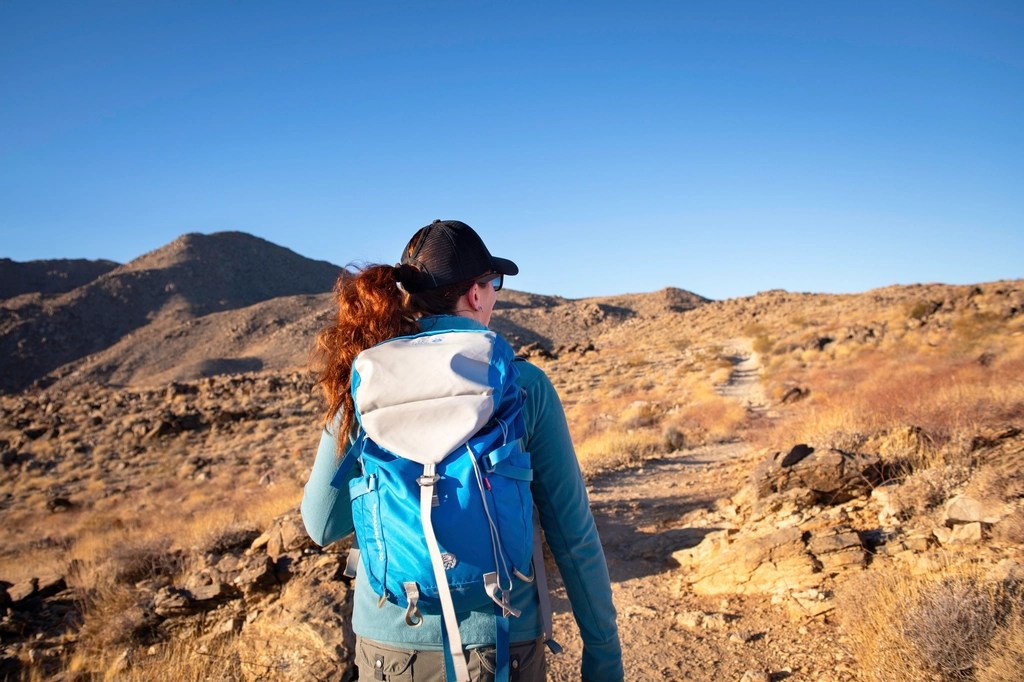
A hiker wearing a backpack looking out over desert terrain. Photo by the National Park Service (public domain, via Openverse).
Search and rescue in the United States is mostly a local function, and understanding how it is organized changes how you plan for it.
Who responds
In most of the country, search and rescue is the responsibility of the county sheriff, and it is executed largely by trained volunteers — NASAR, the field’s professional association, describes SAR as performed primarily by professional volunteers.
In national parks, the Park Service runs its own SAR, responding to roughly 4,500 incidents a year and working with local, county and state agencies through mutual aid. Military and Coast Guard assets participate in specific circumstances. Helicopters come from a mix of agency, National Guard and contracted air ambulance operators.
The consequence is that response capability varies enormously by county, and a remote county may have a small volunteer team with a long drive.
How long it takes
Longer than people expect. A call has to be received, a location established, a team assembled, and the team has to travel — often on foot, in the dark, in the same weather that caused the problem.
Aircraft are weather- and daylight-limited, and cannot fly into cloud, high wind or, in many cases, at night into unfamiliar terrain.
Planning around an overnight self-rescue is more realistic than planning around a helicopter.
Whether you get billed
This varies by state and situation. Many jurisdictions do not charge for the search itself, on the reasoning that fear of a bill delays calls and makes outcomes worse. The Park Service is explicit: NPS will not charge for rescues under its management policies, with narrow exceptions for court-ordered restitution and for private contractors who bill directly.
Medical transport is different: air ambulance billing is a separate commercial matter and can be very large regardless of who conducted the search.
Some states permit cost recovery where negligence or a violation is involved, and a few sell voluntary rescue cards.
Satellite messengers
A satellite messenger or personal locator beacon works where a phone does not, and it transmits a location — the single most valuable piece of information a team can have. A registered 406 MHz beacon routes through the international COSPAS-SARSAT system. Agencies caution that these devices have operational limits and can fail, and should not be treated as a guarantee of rescue.
It does not summon a helicopter. It initiates a process. And the two-way models are more useful than one-way beacons because responders can ask what is wrong and size the response.
The thing that helps most
Leaving a plan with someone — where you are going, the route, when you will be back, what vehicle — is free and it converts a search into a rescue.
A search that starts with a defined area finishes in hours. One that starts with a state finishes in days.
What to tell them, and how
When a call does get through, the quality of the information decides how the response is shaped, and most people give it in the wrong order.
Location first, in coordinates if you have them, and stated slowly with the format identified — degrees and decimal minutes and decimal degrees look similar and place you in different valleys. Then the nature of the emergency, the number of people, and whether anyone is injured and how. Then your resources: shelter, water, warmth, battery.
Say it early and say it twice, because a marginal cell or satellite connection may not survive the whole conversation. If you can only send one text message, it should contain coordinates and the word describing the problem, nothing else.
Then stay where you are, if it is safe to. A party that moves after reporting a position turns a rescue back into a search, and moving at night in terrain is how a manageable situation becomes a second casualty.
Making yourself findable
Searchers work with what contrasts. Bright fabric spread on the ground, a fire where conditions permit, and open ground rather than tree cover all shorten the odds substantially.
A signal mirror is startlingly effective in sun and weighs nothing. A whistle carries further than a voice and does not tire. Both work at times an aircraft cannot fly, which is most of the night and much of bad weather.
If you hear an aircraft, movement is what reads from above — a waving jacket beats a stationary figure. And the standard advice about ground-to-air signals is worth remembering: large, geometric, high-contrast, and bigger than feels necessary.
Sources
- National Park Service, Search and Rescue Policy — no charge for rescues
- National Park Service, Search and Rescue — Aviation
- NOAA, SARSAT Search and Rescue — 406 MHz distress beacons
- National Association for Search and Rescue
This article was researched and drafted with the assistance of AI tools and reviewed, fact-checked and edited by Leonidas Clark before publication. Rules vary by agency and unit; check the managing office before you go.