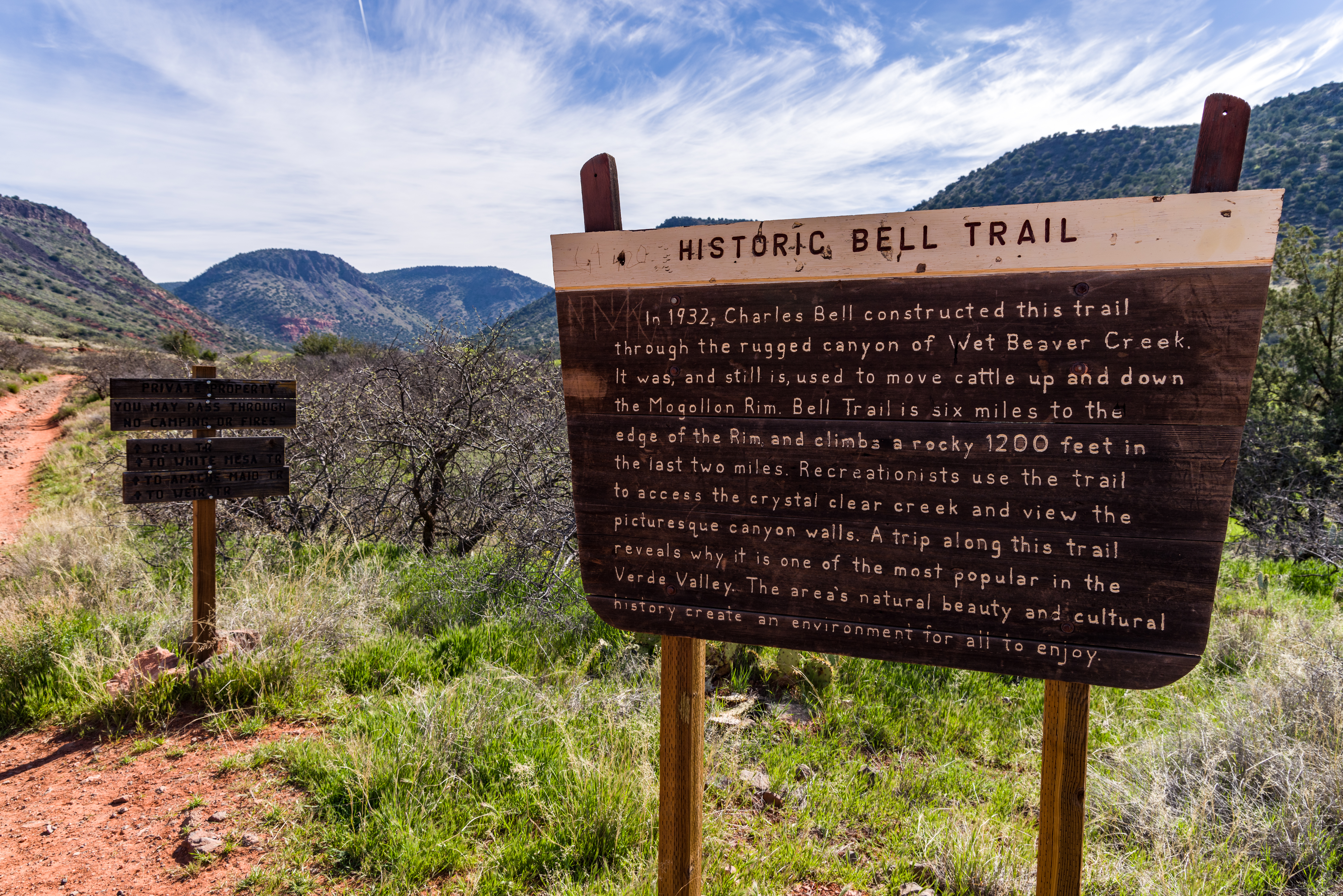
The Historic Bell Trail sign in Coconino National Forest. Photo by Coconino National Forest (public domain, via Openverse).
“Wilderness” in casual use means remote country. In federal land management it is a specific statutory designation under the Wilderness Act of 1964, and it carries specific prohibitions.
What is prohibited
Section 4(c) of the Act states that within designated Wilderness there shall be no temporary road, no use of motor vehicles, motorized equipment or motorboats, no landing of aircraft, no other form of mechanical transport, and no structure or installation, except as necessary to meet minimum requirements for administration. That covers chainsaws, generators and — the one that catches most people — bicycles.
Mountain bikes are not permitted in designated Wilderness. Agencies treat a bicycle as mechanical transport within the meaning of Section 4(c), so this is a statutory prohibition rather than a local trail rule — which is why Wilderness boundaries matter so much to cyclists.
Landing aircraft, including drones, is prohibited. Drone use is treated as both aircraft landing and motorized equipment.
What is allowed
Hiking, saddle and pack stock, non-motorized canoes, rafts and kayaks, hunting and fishing under state regulation, and camping — subject to unit-specific rules. Wheelchair use by people with disabilities is expressly permitted. Motorboat and aircraft use that predates a wilderness designation may also be allowed to continue.
Wilderness designation does not close land to hunting or fishing. That misconception is common and wrong.
Group size and permits
Many Wilderness areas cap group size, often between six and twelve people including stock, to limit site impact.
Permits are required in some areas and quota-limited in a subset of those — the well-known ones fill within minutes of release. Quotas exist because use concentrated on a few corridors degrades them faster than they recover.
Who manages it
Wilderness areas exist within national forests, national parks, BLM land and wildlife refuges, and the managing agency sets the local rules on top of the statutory ones.
So the answer to “what are the rules here” depends on both the designation and the agency, which is covered in our explainer on who manages which public land.
Why 1964 still governs
The Wilderness Act created a system rather than a place. Congress designates each area individually, which is why Wilderness exists inside national forests, parks, refuges and BLM land simultaneously, and why the managing agency differs from one to the next while the statutory prohibitions do not.
Section 4(c) is short and absolute in its wording: no temporary road, no motor vehicles, no motorized equipment or motorboats, no landing of aircraft, no other form of mechanical transport, and no structure or installation, except as necessary for administration of the area.
The mechanical transport question
That last exception is narrower than it sounds, and it is why agencies use crosscut saws rather than chainsaws for trail clearing in Wilderness. It is also the basis for the bicycle prohibition: a bicycle is mechanical transport within the meaning of the section, regardless of the fact that it has no engine.
Wheelchairs are the express carve-out. Their use by people with disabilities is specifically permitted, which is a statutory decision rather than an agency courtesy.
Planning around a permit
Quota-limited areas release permits on a published schedule, often months ahead, and the popular ones are gone within minutes. Where a walk-up allocation exists it is usually small. Group size caps apply to the whole party including stock, and splitting a large group into two camps a mile apart is generally treated as one group rather than two.
Sources
- The Wilderness Act of 1964 (Public Law 88-577), via Wilderness.net
- Wilderness.net, Understanding the Prohibition of Mechanical Transport (PDF)
- US Forest Service, A Cheat Sheet for Demystifying the Wilderness Act (PDF)
- Wilderness.net, Recreation in Wilderness
This article was researched and drafted with the assistance of AI tools and reviewed, fact-checked and edited by Leonidas Clark before publication. Rules vary by agency and unit; check the managing office before you go.