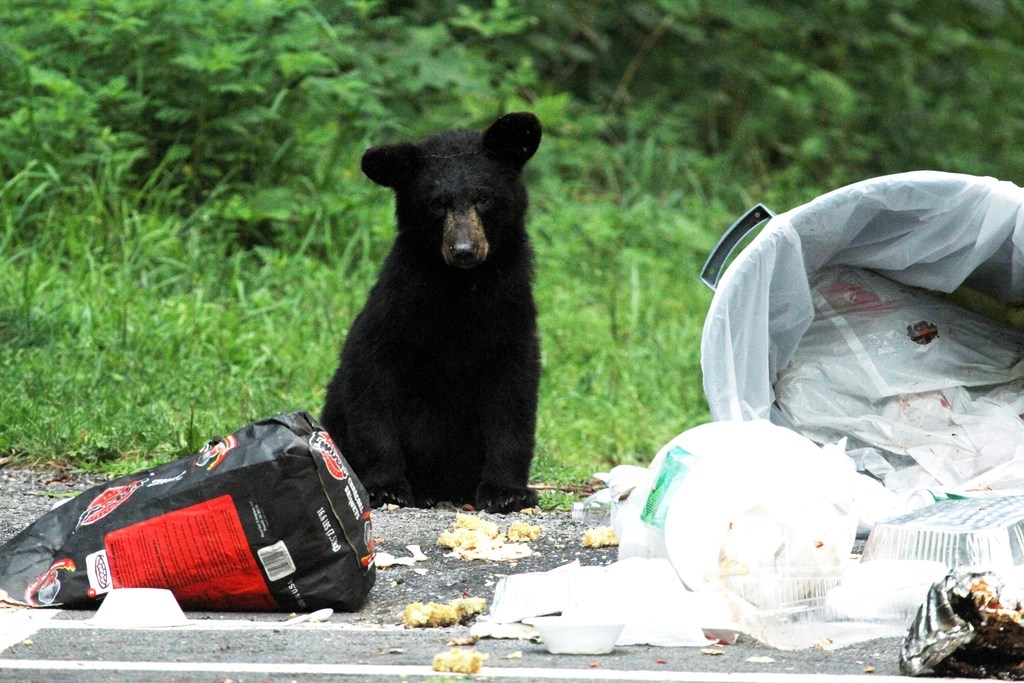
A black bear foraging in trash at a campground. Photo by the National Park Service (public domain, via Openverse).
In much of the West, food storage is governed by a numbered Forest Order issued by the managing unit, defining exactly what counts as acceptable storage of food, refuse and other bear attractants. It is enforceable, it is specific, and violating it carries a citation.
What the order usually requires
Food, garbage and anything with an odor — toiletries, sunscreen, cooking gear, pet food — stored in a hard-sided vehicle, a provided food locker, or an approved bear-resistant container.
Approved containers are tested and listed. Orders typically require a container on the current Interagency Grizzly Bear Committee bear-resistant products list, or one approved through its Courtesy Inspection Program. A cooler with a strap is not an approved container, and neither is a stuff sack. Note too that IGBC certification does not by itself mean a product is approved everywhere — the managing unit decides.
Hanging is accepted in some areas and not others. Where it is permitted, the specification is exact: at least 10 feet clear of the ground at all points and four feet horizontally from any supporting tree or pole. Elsewhere it is disallowed outright, generally because local bears have learned to defeat hangs. Electric fencing and locked hard-sided vehicles or buildings are accepted alternatives in some orders.
Why the rule is strict
A bear that gets human food once will look for it again, and the behavior escalates: approaching camps, then entering them, then damaging vehicles and structures.
Once a bear reaches that stage, relocation usually fails and the animal is destroyed. That is the outcome the order exists to prevent, and it is why enforcement is not discretionary in the way other camping rules sometimes are.
The parts people get wrong
The order applies during the day, not only overnight. An unattended cooler at a picnic table at noon is a violation.
It applies to a full vehicle in some areas — in places with a history of bears breaking into cars, a hard-sided vehicle may not be an approved location, and only a locker will do.
And it applies to empty containers and wrappers. Odor is the trigger, not contents.
Beyond bears
The same discipline matters where the animals are smaller. Rodents chew through packs and gear, and in some regions they carry disease. Food storage is a habit, not a bear-specific procedure.
What counts as an attractant
Orders define attractants broadly and the list surprises people: food and drink, trash, cooking gear and utensils, dishwater, toiletries, sunscreen, insect repellent, pet food, livestock feed, and anything else with an odor. Empty wrappers and used cookware count, because odor is the trigger rather than contents.
Approved storage, precisely
Where a container is required it generally must appear on the current IGBC bear-resistant products list or have passed the Courtesy Inspection Program. A cooler with a strap is not one; nor is a stuff sack, a car boot on some units, or a hard-sided vehicle where the order excludes it.
IGBC certification does not automatically mean approval everywhere. The managing unit decides, and its order is the document that governs.
Why enforcement is not discretionary
A bear that obtains human food escalates: approaching camps, entering them, then damaging vehicles and structures. Relocation usually fails at that point and the animal is destroyed. The order exists to prevent that outcome, which is why it is enforced during the day as well as overnight and why an unattended cooler at a picnic table at noon is a citation.
Sources
- Interagency Grizzly Bear Committee, Food Storage Regulations
- Interagency Grizzly Bear Committee, Bear Resistant Products — certified products list and inspection program
- Bridger-Teton National Forest, Food Storage order — hanging and storage specifications
- White River National Forest, Bear Resistant Containers
This article was researched and drafted with the assistance of AI tools and reviewed, fact-checked and edited by Leonidas Clark before publication. Rules vary by agency and unit; check the managing office before you go.