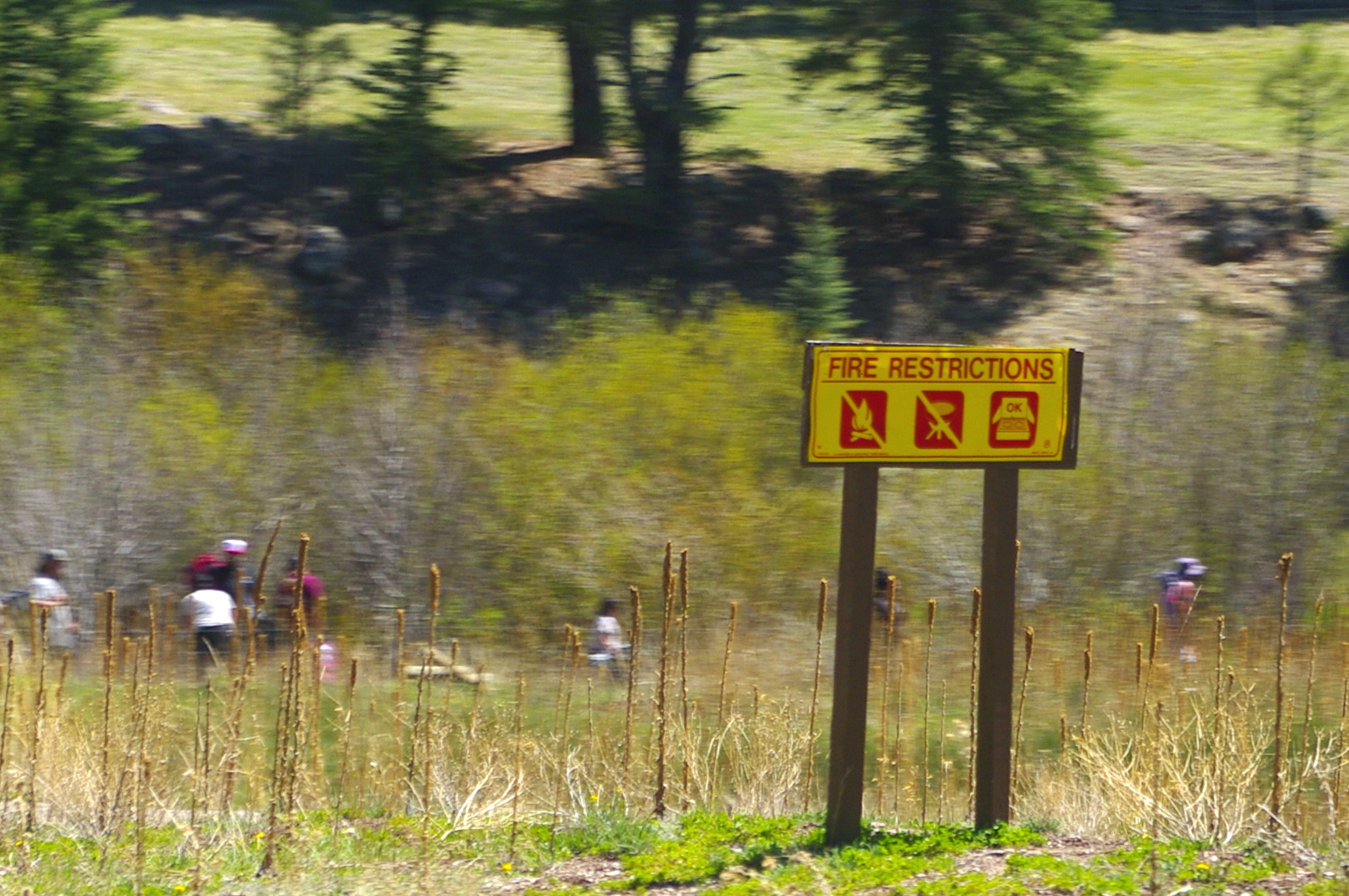
A fire restrictions notice board posted in Santa Fe National Forest. Photo by Winter.lbbh (CC0, via Openverse).
Fire restrictions on federal land are not a general warning to be careful. They are orders with specific prohibitions, and they are enforceable.
Stage 1
Typically prohibits building, maintaining or using a fire outside an agency-approved and installed fire pit or grate, with gas-fueled devices that have an on/off switch usually still permitted. Smoking is restricted to an enclosed vehicle or building, a developed recreation site, or a cleared area at least three feet across.
Stoves and lanterns using pressurized liquid or gas fuel are usually still permitted, because they can be shut off instantly.
Stage 2
Extends the prohibition to all fires anywhere on the forest, including charcoal and briquettes and including developed recreation sites. Chainsaw and equipment restrictions come with a time window — commonly no sawing between 1pm and 8pm — plus a requirement to carry a long-handled shovel and a fire extinguisher and to keep a one-hour fire watch after stopping.
Pressurized-fuel stoves usually remain legal even at Stage 2, which surprises people who assume all cooking is banned.
Area closure
The strongest measure: entry to a defined area is prohibited entirely, roads and trails included. This is issued under closure authority, not fire restriction authority, and violating it is a separate offense.
Why the stages differ between adjacent units
Restrictions are issued by the local managing unit. The Forest Supervisor holds the authority for campfire, smoking and chainsaw restrictions and recommends area closures to the Regional Forester, working from fire preparedness level, current fire occurrence and projected season severity — not from a national switch. Idaho ran Stage 1 and Stage 2 simultaneously on neighboring units for exactly this reason.
So a national forest can sit at Stage 2 while the BLM land across the road is unrestricted, and both decisions can be correct. Checking the specific unit is the only reliable approach.
Vehicle rules people miss
Spark arresters are not just a restriction-stage rule: operating any internal or external combustion engine without a properly installed and maintained spark arrester meeting Forest Service Standard 5100-1 is prohibited year-round. Restrictions typically add a shovel and fire extinguisher in the vehicle. Parking on dry grass is frequently prohibited because catalytic converters ignite it.
That last one causes real fires. It is not a technicality.
Why neighboring units differ
Restrictions are issued by the local managing unit on local indicators: fuel moisture, energy release component, fire activity and available resources. There is no national switch, which is why a national forest can sit at Stage 2 while BLM land across the road is unrestricted and both decisions are correct.
It also means restrictions can move in either direction mid-season. A wet week can lift them; a wind event can escalate them overnight.
Equipment rules people miss
Spark arresters are required year-round on Forest Service land, not only during restrictions, and the standard is specific — a device meeting Forest Service Standard 5100-1, properly installed and maintained. An arrester present but clogged counts as absent.
Restrictions typically add a shovel and fire extinguisher carried in the vehicle, and a one-hour fire watch after any sawing or grinding work.
Checking before you go
Restrictions and closures are published by the unit, usually on its alerts page, and they change. The practical habit is checking the specific unit within a day or two of leaving, rather than relying on what was true when the trip was planned.
Sources
- Deschutes National Forest, Public Use Fire Restrictions — stage definitions and spark arrester standard
- Coconino National Forest, Fire Restrictions — who issues restrictions and closures
- Idaho Panhandle National Forests, Fire Danger Prompts Stage 1 and 2 Fire Restrictions
- Bureau of Land Management, Rocky Mountain District Fire Restrictions
This article was researched and drafted with the assistance of AI tools and reviewed, fact-checked and edited by Leonidas Clark before publication. Rules vary by agency and unit; check the managing office before you go.