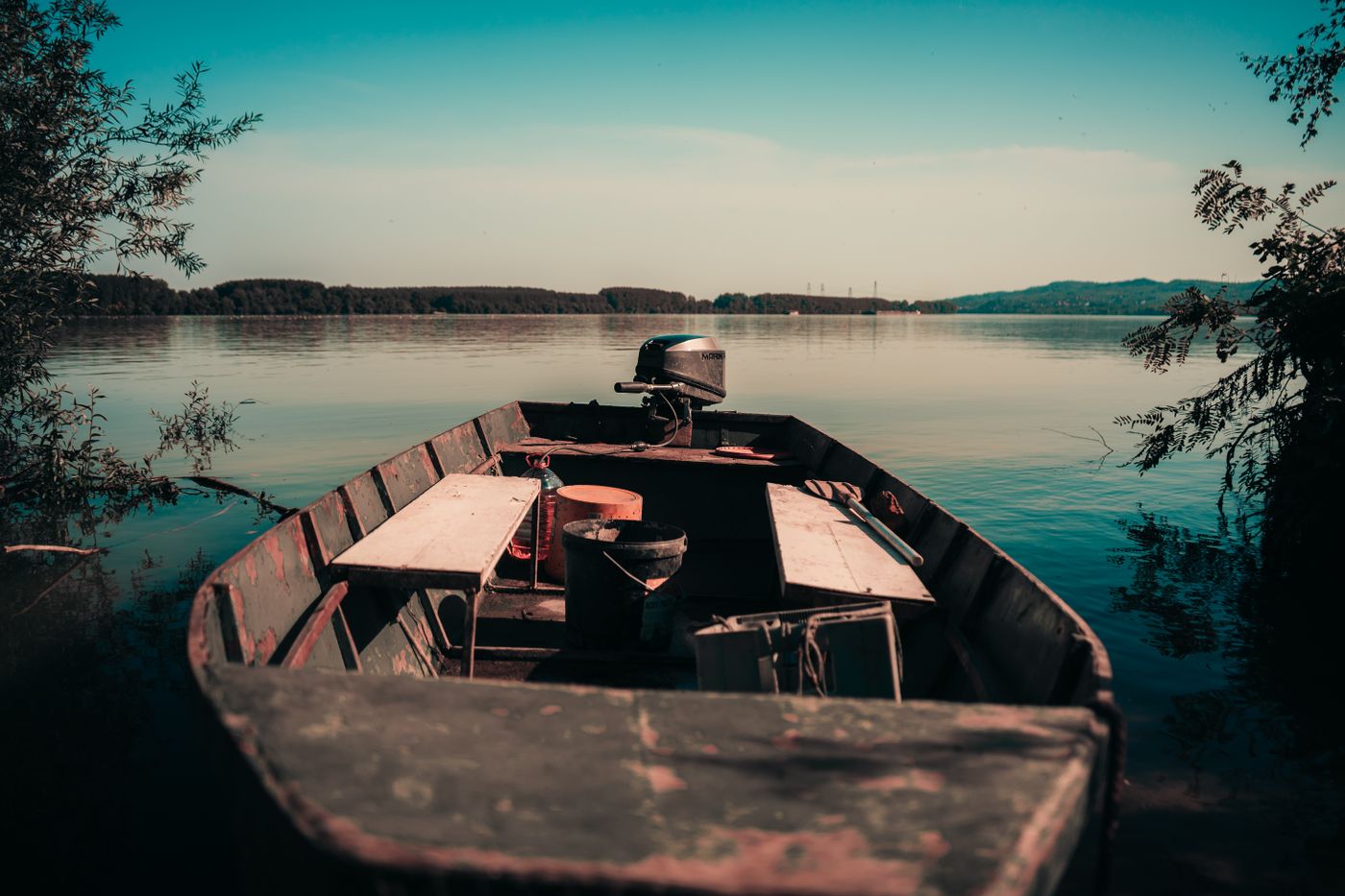
A wooden boat moored on a calm lake. Photo via Pexels.
Aquatic invasive species are moved between waters almost entirely by people, and the vector is usually a boat, a trailer or a pair of waders.
What is being prevented
Zebra and quagga mussels colonize hard surfaces, clog water intakes and infrastructure, and strip plankton out of a food web. Once established in a lake, they are effectively permanent.
Invasive plants such as hydrilla and Eurasian watermilfoil form dense mats that crowd out native vegetation and make water unusable for boating and swimming.
Whirling disease and other pathogens travel in water and on wet gear.
The common feature is that eradication after establishment is rarely possible. Prevention is the whole strategy, and it is backed by real penalties — moving a watercraft with mussels attached is a class A misdemeanour in Utah, with fines and seizure of the boat available.
The protocol
Clean. Remove all visible plants, animals, mud and debris from the boat, trailer, motor and gear before leaving the access.
Drain. Empty every space that holds water — livewells, bilge, ballast, motor, buckets. Many states require drain plugs removed during transport, and that is an enforceable rule: Utah reports that failing to pull drain plugs while trailering is one of its two most common invasive-species violations.
Dry. Allow everything to dry completely before entering another water, and the required time is often written into the rule rather than left to judgment. Utah sets seven days in summer, 18 in autumn and 30 in winter — and 30 days regardless of season for any boat that has been on Lake Powell. Where drying is not practical, professional decontamination is the alternative.
Waders and felt soles
Anglers on foot are a vector too. Felt-soled wading boots hold moisture and organisms for a long time and are prohibited in several states for that reason.
Rubber soles dry faster and are the general replacement.
Inspection stations
Many western states operate mandatory watercraft inspection stations, and passing one without stopping is a violation. Utah runs more than 40 inspection and decontamination stations and inspected close to 300,000 boats in a single season. Some states require decontamination certificates for boats arriving from infested waters.
Those stations exist because the cost of a single introduction — to a water body, to municipal infrastructure — is orders of magnitude greater than the cost of inspecting every boat that passes.
Why felt soles are banned in places
Felt holds moisture and organic material far longer than rubber, and it does so in a material that is impossible to inspect properly. Several states prohibit felt soles for that reason. Rubber soles dry faster and can actually be cleaned, which is the whole argument.
What travels besides mussels
Aquatic plants such as hydrilla and Eurasian watermilfoil move as fragments on a trailer bunk. Whirling disease and other pathogens travel in residual water and on wet gear. New Zealand mud snails survive for days in damp felt or laces and are effectively impossible to eradicate once established.
The protocol is one procedure for all of them, which is why it is stated as three words rather than a species list.
Decontamination as an alternative
Where drying is impractical, hot-water decontamination substitutes for time — Utah runs it as a formal alternative to the full clean, drain and dry cycle, with certificates issued at inspection stations. Passing a mandatory station without stopping is a violation in its own right, separate from anything found on the boat.
Sources
- Utah Division of Wildlife Resources, Aquatic Invasive Species: quagga mussels, milfoil & more
- Utah Division of Wildlife Resources, Invasive mussels — clean, drain, dry requirements and drying times
- Utah Division of Wildlife Resources, Nearly 300,000 boats inspected for quagga mussels during 2024 boating season
This article was researched and drafted with the assistance of AI tools and reviewed, fact-checked and edited by Leonidas Clark before publication. Rules vary by water and state; confirm before you fish.