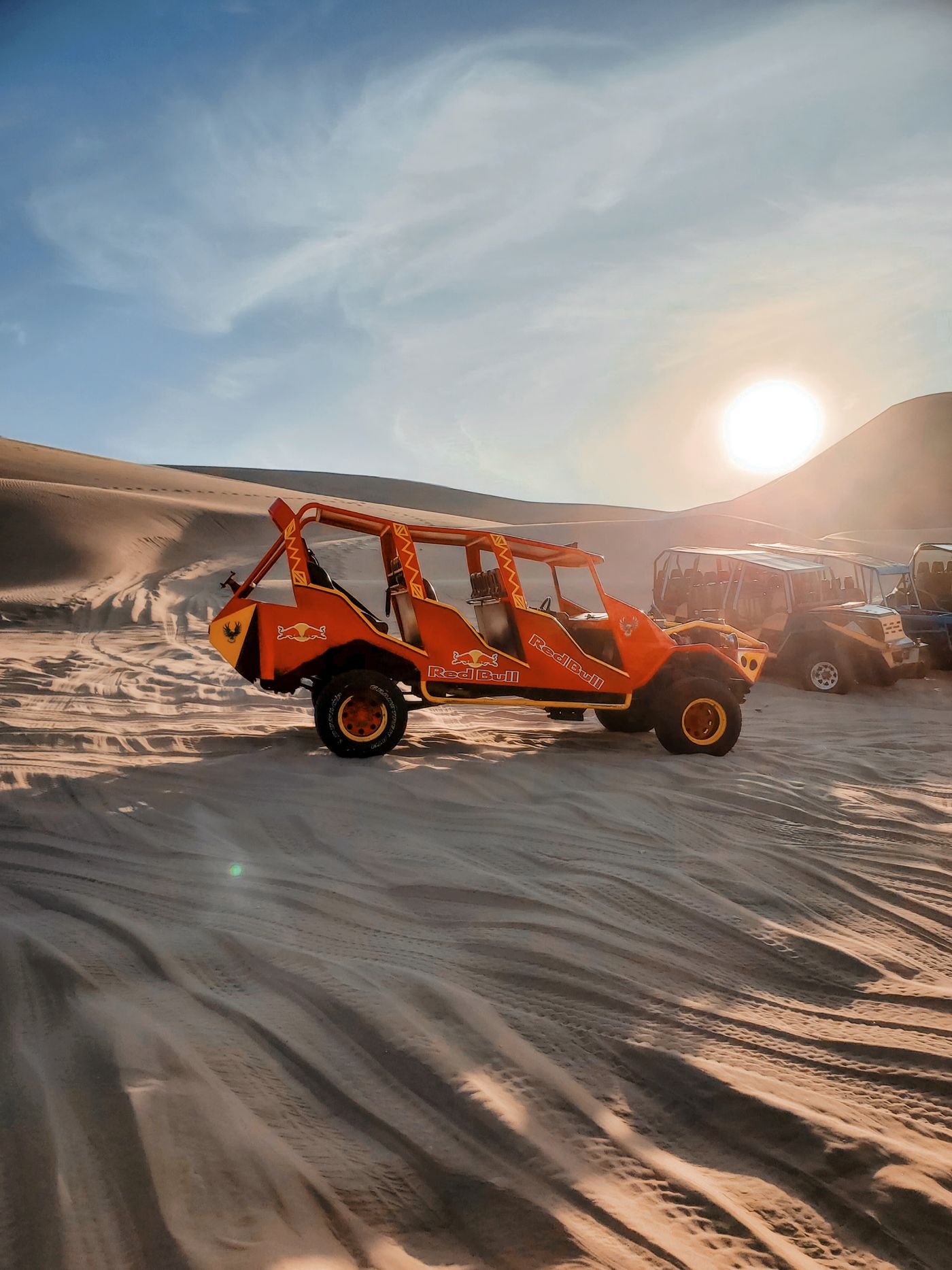
An off-road buggy parked on sand dunes with the sun low in the sky. Photo via Pexels.
Vehicle recovery uses two fundamentally different tools, and the difference is about energy.
Kinetic recovery ropes
A kinetic rope stretches substantially under load — commonly around a fifth to a third of its length — and returns that stored energy to pull the stuck vehicle out.
The recovering vehicle takes a run at it, the rope stretches, and the stored energy does work the vehicle alone could not.
That energy is the point and the hazard. A kinetic rope under load holds a great deal of it, and a failure at either end releases it instantly.
Sizing is where this goes wrong most often, and it goes wrong in the direction people do not expect. A rope rated far above the vehicle’s weight does not stretch enough under that load to do its job. Instead of storing and releasing energy gradually, it transmits the shock straight through to the recovery points and the frame. Buying the strongest rope on the shelf is not the conservative choice — it is a different failure mode.
Kinetic ropes also age. Nylon loses elasticity through repeated heavy cycles, and it degrades with ultraviolet exposure, abrasion and chemical contamination. A rope that lives in a truck bed in the sun is not the rope it was when new. Stiffness, glazing, cuts through the outer fibers and any section that no longer recovers its original length are all reasons to retire it.
Winch lines
A winch line is designed to stretch as little as possible. The work comes from the winch motor and gearing, applied slowly and controllably.
Steel cable stores more energy than synthetic and recoils viciously if it parts — a recoil hazard long documented in industrial rigging. High-strength synthetic ropes do not store kinetic energy at a comparable level and so do not generate that recoil, which is their main safety advantage. Covered further in our piece on winch ratings and rigging.
The hardware in between
This is where most failures happen. A kinetic rope with metal hooks at the ends turns a stretchy rope into a slingshot with projectiles attached.
Soft shackles exist for this reason — they carry the load without adding a lump of steel to the failure path. Where metal shackles are used, they should be rated recovery shackles carrying a legible working load limit from the manufacturer. That is the standard OSHA applies to rigging: shackles must not be loaded beyond the rated capacity marked on them, and the same logic applies on a trail.
And the anchor points on both vehicles must be rated recovery points. Tow balls, tie-down loops and bumper brackets are the components that come off.
A damper — a heavy blanket, a recovery bag, even a folded jacket weighted down — laid over the middle of the line is cheap insurance. If the line parts, the weight drags the ends down rather than letting them travel. It does not make a bad rig safe, but it changes where the pieces go.
The bystander rule
Everyone not required stands well clear, and “well clear” means further than feels necessary and out of the line’s arc in both directions.
Nobody stands between the vehicles. Nobody stands behind the anchor. Nobody films from the side at close range, which is how a large share of documented recovery injuries occur.
Choosing
A vehicle stuck in something soft that will come free with a firm pull is a kinetic rope situation. A vehicle wedged, on a slope, or needing precise controlled movement is a winch situation.
Snatching a vehicle that is genuinely pinned applies enormous force to components that were not designed for it, and it is how frames and mounts get damaged.
What a controlled recovery looks like
Before anything is attached, the stuck vehicle gets dug out as far as is practical. Removing the obstruction is almost always cheaper than overcoming it, and every inch of clearance lowers the force the recovery has to generate.
Then the rigging is inspected end to end — anchor points, shackles, the rope itself — by someone who touches each one rather than glancing at it. Drivers agree on signals and on who is in charge, because a recovery with two people giving instructions is a recovery with none.
The first attempt is deliberately gentle. If a moderate pull does not move the vehicle, the answer is to reassess, not to take a longer run-up. Escalating force against a vehicle that has not budged is the sequence that breaks things and hurts people.
Sources
- OSHA, 29 CFR 1926.251 — Rigging equipment for material handling
- OSHA, 29 CFR 1917.42 — Miscellaneous auxiliary gear (shackle working load limits)
This article was researched and drafted with the assistance of AI tools and reviewed, fact-checked and edited by Leonidas Clark before publication. Off-road travel carries real risk; you are responsible for your own preparation and judgment.