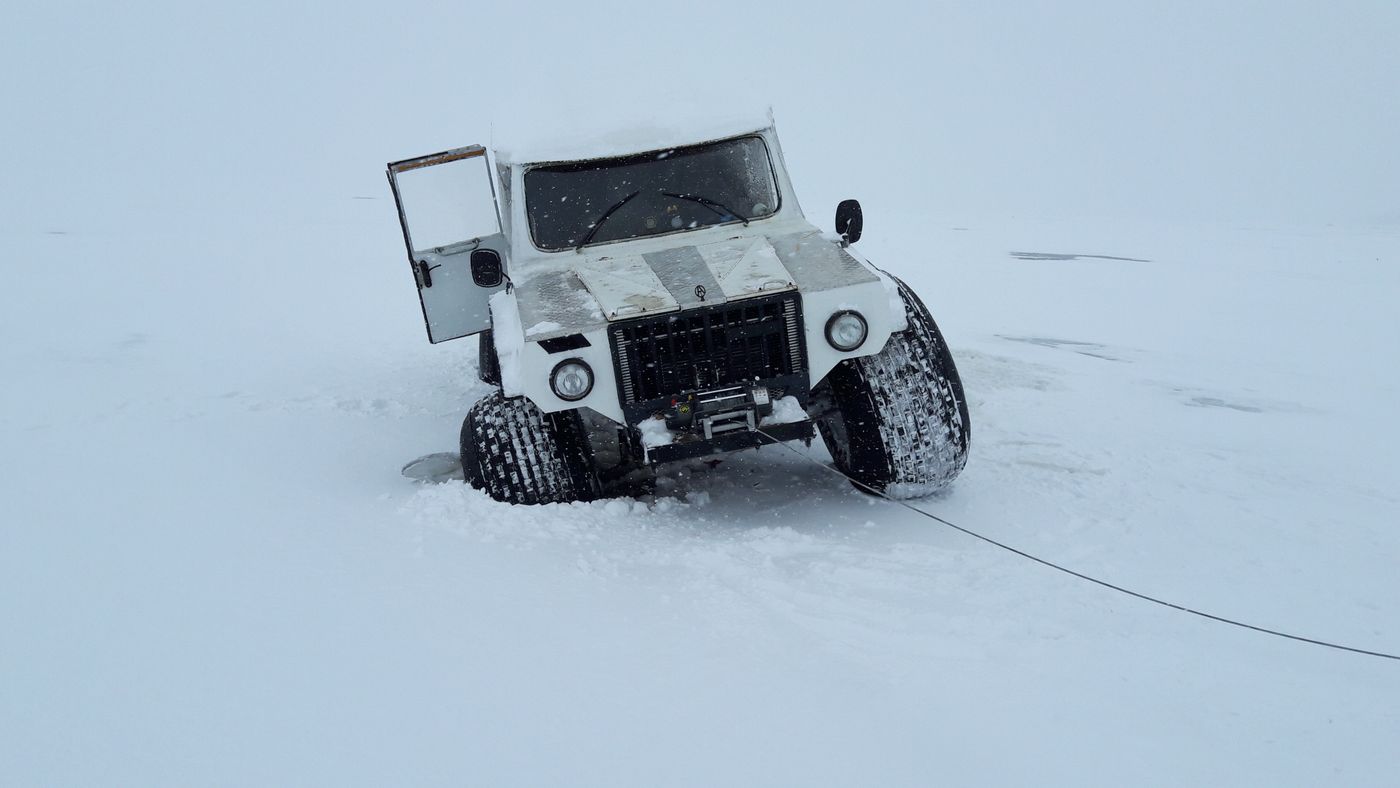
A vehicle being recovered in deep snow. Photo via Pexels.
Vehicle recovery concentrates enormous stored energy in a line under tension, and the injuries it causes are severe. Understanding where the load actually goes is the difference between a recovery and an incident.
What a winch rating means
A winch is rated for its maximum pull on the first layer of line on the drum. Every additional layer reduces available pull, because the effective drum diameter increases.
That means a winch with line spooled to the outer layers is pulling meaningfully less than its rating. Spooling out more line before pulling is not just about reach.
A common rule of thumb sizes a winch at roughly one and a half times vehicle weight, which allows for the fact that a stuck vehicle in mud or against an obstacle resists far more than its own weight.
The chain is only as strong as its weakest component
Recovery loads pass through a sequence: winch, line, hook or thimble, shackle, anchor point, and the vehicle structure behind it.
The rating that matters is the lowest of those. Industrial rigging practice states the principle plainly — shackles must not be loaded beyond the working load limit marked on them by the manufacturer, and rigging equipment must be inspected and removed from service when damaged. A heavy winch bolted to a bumper that was never designed for recovery is a bumper problem, not a winch capability.
This is the single most important distinction on a vehicle: recovery points are not tie-down points. Factory tie-down or transport loops are for securing a stationary vehicle and are frequently not rated for dynamic recovery loads. Using one can tear it out and send it down the line.
Line type changes the failure mode
Steel cable stores energy elastically and, if it fails, whips with lethal force — a recoil hazard long documented in wire rope use. High-strength synthetic lines do not store comparable kinetic energy and so do not produce that recoil.
Synthetic line stores less energy and tends to fall when it breaks rather than recoiling. It is also lighter and easier on the hands, and it is vulnerable to abrasion and UV in a way steel is not.
Neither is safe to stand near under load.
The habits that matter
Lay a damper — a heavy blanket or purpose-made bag — over the line. It absorbs energy and drops the line if it parts.
Keep everyone out of the line’s path and well clear of its potential arc, including behind the anchor.
Never use a tow ball as a recovery point. Ball failures under recovery load are a documented cause of fatalities.
And pull steadily. Snatch recovery with a kinetic rope is a different technique with different equipment; using a winch line as though it were one is how components break.
Layer effect, quantified
A winch is rated on the first layer of line on the drum. Each additional layer increases the effective drum diameter, and pulling power falls roughly in proportion — by the outer layers a winch can be delivering little more than half its rated pull. Spooling out more line before pulling is a capability decision, not just a reach decision.
Rigging to reduce load
A snatch block doubles line pull at the cost of halving speed, and it also lets you redirect a pull around an obstacle or back to the recovering vehicle. It is the single most useful item in a recovery kit after the line itself.
Every component in the chain needs a rating, and industrial practice is unambiguous: shackles must not be loaded beyond the working load limit marked on them by the manufacturer. Unmarked hardware has no place in the chain.
Damping the line
A weighted blanket or bag laid over the line partway along absorbs energy if it parts and drives the ends toward the ground rather than through the air. It costs nothing and it is the difference between a broken line and an injury. Nobody stands in line with the pull, on either side, at any point.
Sources
- OSHA, 29 CFR 1917.42 — Miscellaneous auxiliary gear (shackle working load limits)
- OSHA, 29 CFR 1926.251 — Rigging equipment for material handling
This article was researched and drafted with the assistance of AI tools and reviewed, fact-checked and edited by Leonidas Clark before publication. General information, not legal or mechanical advice for a specific vehicle.