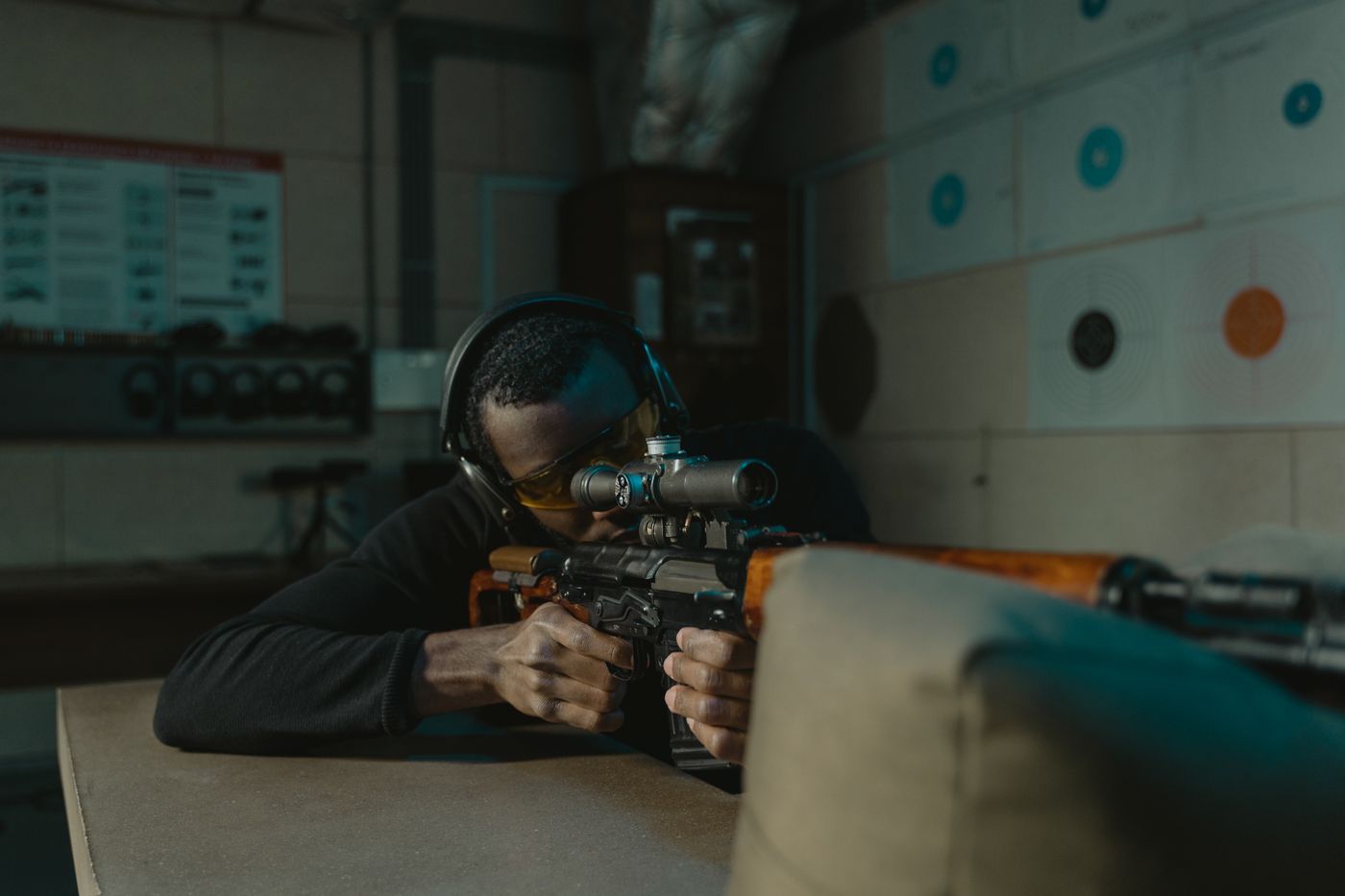
A shooter wearing eye and ear protection aiming a rifle at an indoor range. Photo via Pexels.
One of the most frequently violated rules in hunting has nothing to do with firearms law as most people understand it.
Many states prohibit carrying a loaded firearm in or on a motor vehicle — and that prohibition frequently sits in the wildlife code rather than the firearms code, applies regardless of any carry permit, and often extends to off-road vehicles. Texas is a clear example: on public hunting land you may not possess a loaded firearm within or on a motor vehicle, nor at a designated campsite, parking area, boat launch or check station.
Why the distinction matters
A person with a valid carry permit may reasonably assume it settles the question. It usually does not, because the two rules exist for different reasons.
Carry law is about public safety and self-defense. The vehicle rule in a hunting context is about road hunting — Texas separately prohibits hunting any wild animal or bird from a vehicle on a public road or right-of-way — and about unattended loaded firearms in a truck at a trailhead. It is enforced by game wardens under wildlife authority.
What “loaded” means varies
This is where the detail bites. Definitions differ on whether a round in the magazine, with an empty chamber, counts as loaded.
Some states define loaded as any ammunition in the firearm including the magazine. Others define it as a round in the chamber. Texas defines a loaded firearm as one containing a live round in the chamber and/or magazine — or, if muzzleloading, one with a cap on the nipple or a priming charge in the pan. That last clause is why muzzleloaders are specified separately in most digests.
Getting this right requires reading the definition rather than reasoning from what seems sensible.
Vehicle is broader than truck
The rule commonly extends to ATVs, UTVs and snowmobiles, which matters for anyone using a machine to access hunting ground.
That is worth noting alongside the growing number of states allowing road-registered side-by-sides, such as South Carolina from November. A machine becoming street legal does not change the wildlife rule about a loaded firearm on it.
The habit
Unload before the firearm goes in the vehicle, every time, without treating short moves between stands as an exception. Most citations come from short moves.
And check the definition of loaded in the state you are hunting, because the answer to “is this loaded” is a legal question before it is a mechanical one.
Where the rule usually sits in the code
Because this prohibition lives in the wildlife code, it is not where a search for firearms law will find it. The usual location is the hunting regulations under a heading about unlawful methods of take, alongside rules on spotlighting and shooting from a roadway — which is a clue to its purpose.
The rule exists mainly to prevent road hunting: shooting from or across a vehicle at game spotted from the road. A loaded firearm in the cab is the element the state can actually observe and prove, so that is what the prohibition attaches to.
Related provisions usually sit in the same section and catch people for the same reason. Discharging a firearm from a roadway or within a set distance of one, shooting across a public road, and using a vehicle to pursue or position on game all tend to appear together, and all of them apply whether or not anyone is hunting at the time.
Where enforcement actually happens
Game wardens generally have authority to stop and inspect in circumstances where an ordinary traffic stop would require more, and vehicle checks during open season are routine rather than exceptional. A firearm in a case behind the seat will be looked at.
The practical consequence is that the person most likely to be caught by this rule is not someone behaving badly. It is someone moving between stands, or driving out at the end of legal light with a round still in the chamber because unloading felt like a formality with the truck fifty yards away.
Building the habit around the vehicle rather than around the hunt solves it. The firearm is unloaded before it goes in, every time, including for the short move — and the magazine, the chamber and whatever else that state counts as loaded are all dealt with at once.
Sources
- Texas Parks & Wildlife, Hunting Means and Methods — general regulations
- Texas Parks & Wildlife, Annual Public Hunting: What You Need to Know — loaded firearm definition and vehicle prohibition
- Texas Parks & Wildlife, Transporting Firearms (hunter education)
This article was researched and drafted with the assistance of AI tools and reviewed, fact-checked and edited by Leonidas Clark before publication. It is general information, not legal advice. Confirm current rules with the relevant agency.