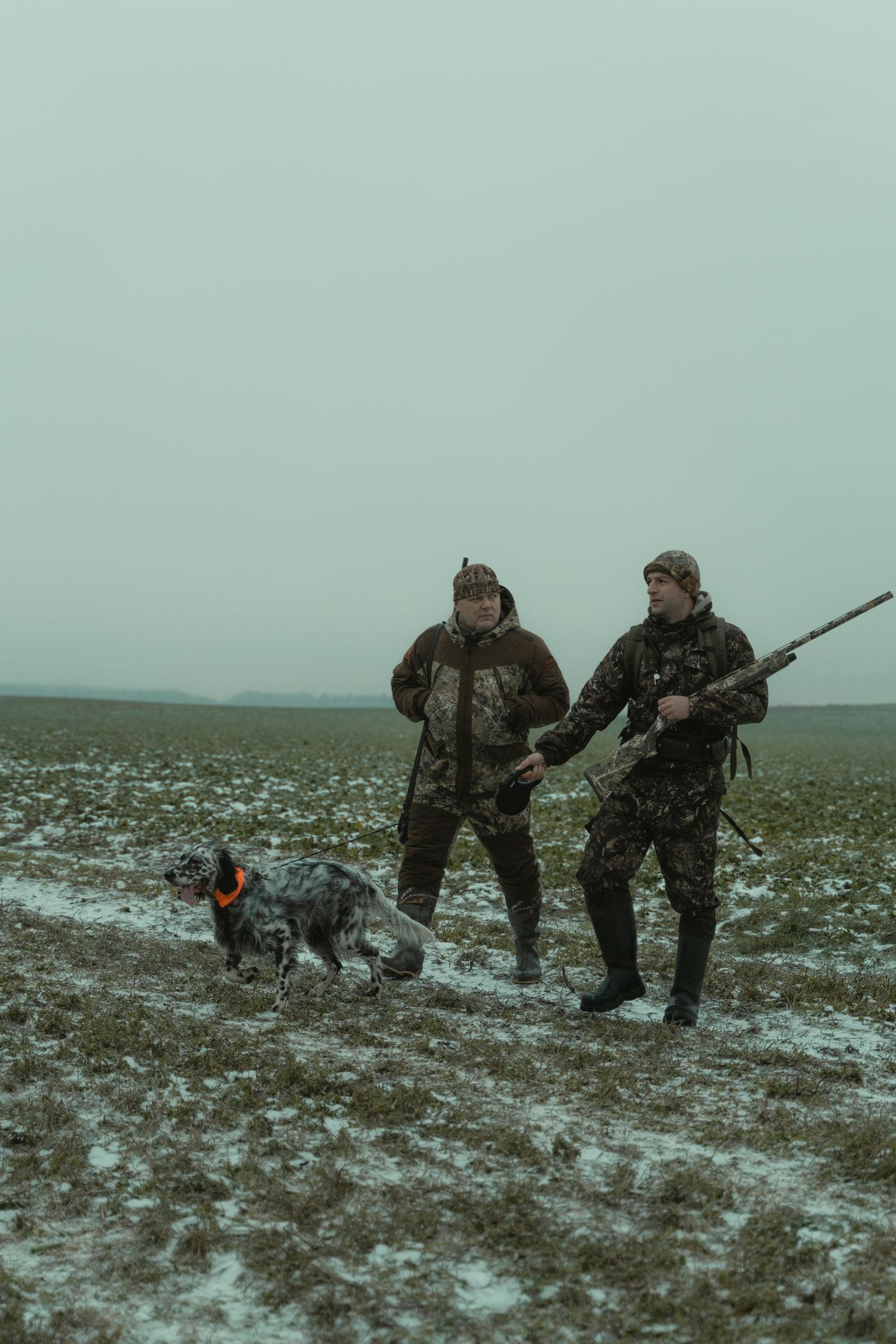
Two hunters with shotguns walking a field with a dog. Photo via Pexels.
Party hunting — the practice of a group filling tags collectively — is legal in some states, illegal in others, and permitted in narrow forms in others still. The assumption that a familiar practice travels is a reliable way to commit a violation.
The underlying question
The rule turns on a simple question: may a licensed hunter kill an animal that is then tagged by a different licensed hunter?
States that prohibit this treat the tag as personal to the person who fired the shot. Texas is explicit: a hunter may not use a tag from another person’s license, may not let anyone else use their tags, and may not use a tag more than once. States that permit party hunting treat the group as the unit, usually with conditions about who must be present and how close.
Where it is permitted, the conditions are specific: all participants licensed and holding valid unfilled tags, present in the field, sometimes within a defined distance or in visual contact.
Tagging is separate and stricter
Whatever the party rules, tagging requirements are usually precise about timing and method.
Common requirements include attaching the tag immediately upon harvest and before moving the animal, recording date and time, and notching or validating in a specified way. In Texas the tag must be legibly completed, including the property name and county, and immediately attached. Some states require the tag to remain attached until the animal is processed.
“Immediately” tends to mean immediately. The gap between shooting an animal and dragging it to a truck is exactly where enforcement finds problems.
Reporting is a third thing
Many states now require harvest reporting within a set window through a phone system, website or app — Pennsylvania runs tagging and reporting as two distinct obligations with their own deadlines.
That is separate from tagging and separate from any check-station requirement. Missing it is a violation even where the animal was lawfully taken and correctly tagged.
Before hunting with a group
Establish whether party hunting is permitted where you are, and if so under exactly what conditions. Establish who tags what before anyone shoots, not after.
The disagreement worth avoiding is the one that happens over a dead animal at last light with two people holding different assumptions about whose tag it is.
Why states split on this
The disagreement is about what a tag represents. Treated as a personal authorization to take one animal, a tag cannot be filled by anyone but the person who fired. Treated as a quota allocation to a licensed group hunting together, it can.
Neither reading is obviously right, which is why the map looks arbitrary. What is not arbitrary is that Texas prohibits using another person’s tag outright, and states that permit party hunting hedge it with conditions about presence and proximity.
Getting it wrong is a serious offense
Tagging violations are not treated as paperwork. They sit close to unlawful take in most codes, because a mis-tagged animal defeats the harvest accounting the quota depends on. Penalties commonly include license suspension alongside fines.
Settle it before the hunt
Establish whether party hunting is permitted where you are, and if so under exactly what conditions — who must be licensed, who must be present, how close. Then decide who tags what before anyone shoots.
The disagreement worth avoiding is the one that happens over a dead animal at last light with two people holding different assumptions about whose tag it is.
Sources
- Texas Parks & Wildlife, Tagging Deer — Outdoor Annual tagging instructions
- Pennsylvania Game Commission, Tagging & Reporting Your Deer
- Texas Parks & Wildlife, General Hunting Rules & Regulations
This article was researched and drafted with the assistance of AI tools and reviewed, fact-checked and edited by Leonidas Clark before publication. It is general information, not legal advice. Confirm current rules with the relevant agency.