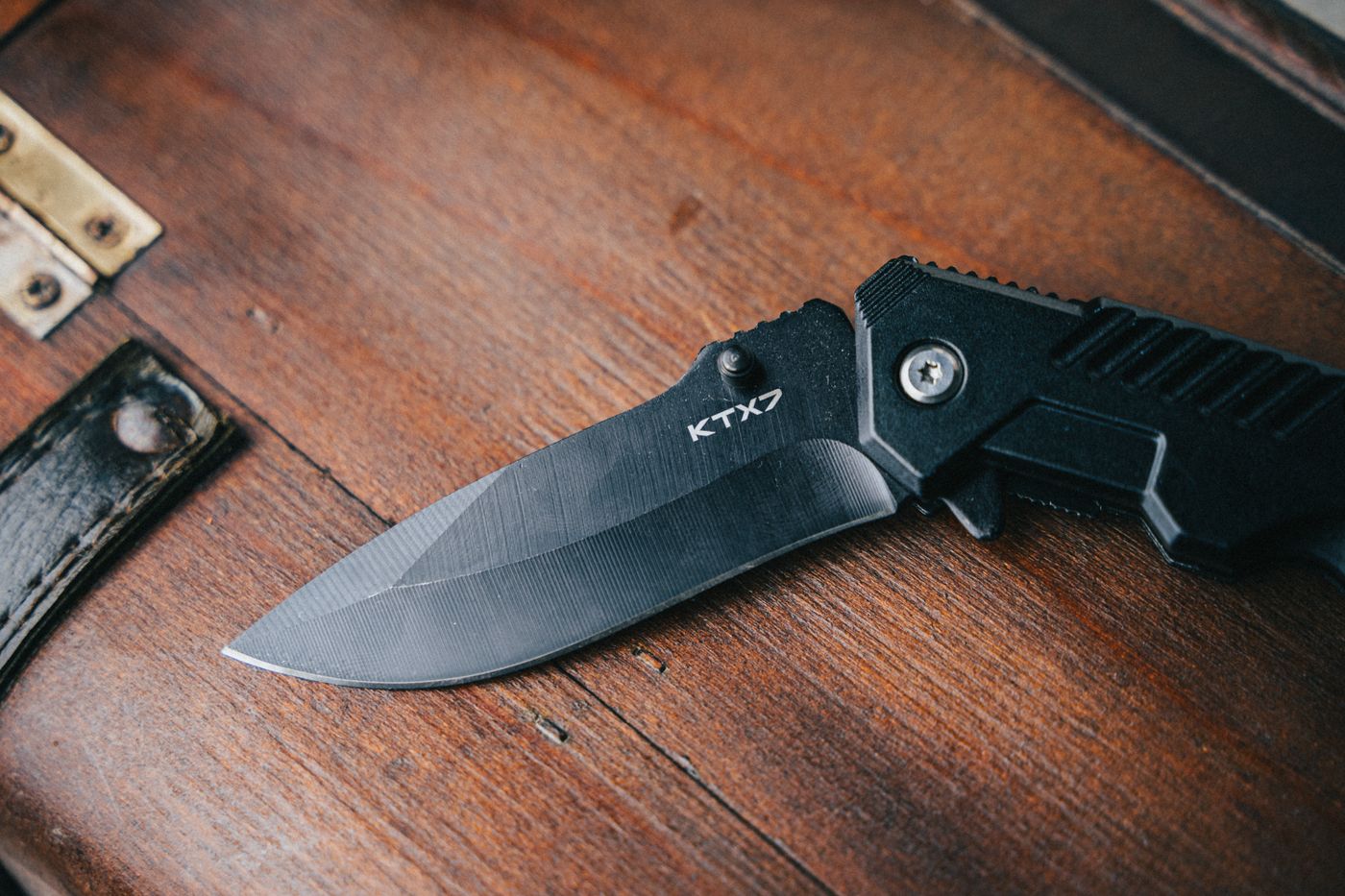
A black folding knife open on a wooden surface. Photo via Pexels.
We have covered what federal knife law covers — manufacture, interstate commerce and importation under 15 U.S.C. Chapter 29 — and why that leaves ownership and carry to the states.
This is the practical follow-on: how to find the rule that applies to you, without relying on a chart that may be years out of date.
Step one: the state statute
Every state publishes its current code online, and that text is authoritative in a way no summary is.
Search for your state name plus “code” or “revised statutes,” then look for the criminal offenses title, and within it weapons offenses. The terms that matter are usually “dangerous weapon,” “deadly weapon,” or a specific enumeration of knife types.
Read the definitions section as well as the offense. Statutes routinely turn on a defined term, and the definition frequently does not match ordinary usage. Federal law shows the pattern: the switchblade definition sits in 15 U.S.C. § 1241, the exceptions in § 1244, and the park-regulation definition of “weapon” in 36 CFR § 1.4 rather than in the prohibition it governs.
Step two: preemption
Preemption determines whether cities and counties may write their own knife rules.
In a state with knife preemption, the state statute is generally the whole answer. In a state without it, a knife that is lawful statewide can still be prohibited by a municipal ordinance, and you would have no way of knowing from the state code alone.
Search your state code for “preemption” alongside “knife” or “weapon.” If it exists, it is usually a short, clearly-worded section.
Step three: local ordinance, if needed
If your state lacks preemption, check the municipal code for the city and the county you are in. Most publish searchable codes online.
This is also where the answer changes as you drive, which is worth remembering on a trip that crosses several jurisdictions.
The separate questions
Five things are usually governed separately, and a single answer to “is this legal” often conflates them:
Ownership. Open carry. Concealed carry. Restricted places — schools, courthouses, government buildings, secure areas of airports. And rules for minors.
A knife can be lawful to own, lawful to carry openly, unlawful to conceal, and unlawful in a particular building, all at once.
And when it matters
If the answer has real consequences — you are moving, traveling with a collection, or facing an actual legal question — talk to a lawyer in that state.
This is general information about how to find the law, not legal advice about what it means for you.
What to read once you have found the statute
Finding the law is the easy half. Reading it usefully means looking for four things in a specific order.
Start with the definitions section, because the operative terms are almost never used in their ordinary sense. What counts as a “switchblade,” a “dirk,” a “gravity knife” or a “dangerous weapon” is set out there, and a blade that is obviously none of those in plain English may sit squarely inside one of the statutory definitions.
Then find the conduct the statute actually prohibits. Possession, concealed carry, open carry, sale and carry in specified locations are distinct offenses with distinct elements, and a statute may reach only one of them.
Then look for the exceptions, which are frequently in a separate subsection and frequently broader than the prohibition suggests. Exceptions for lawful hunting and fishing, for transport in a vehicle, and for tools carried in the course of work appear in many state codes and are the provisions that cover most outdoor use.
Finally check the penalty provision, which tells you whether you are reading about an infraction or a felony. That determines how much the rest of it matters.
Why charts and summaries go stale
Knife law has moved faster in the last fifteen years than almost any other category of weapons law, largely in the direction of repeal and preemption. A chart compiled a few years ago may describe a prohibition that no longer exists, or miss a preemption statute that has since overridden a city ordinance you would otherwise have worried about.
The reverse also happens. A summary can report a repeal that was proposed and never passed. The state code itself carries no such risk, which is the whole argument for going to it.
Sources
- 15 U.S.C. Chapter 29 — Manufacture, Transportation or Distribution of Switchblade Knives (Cornell LII)
- 15 U.S.C. § 1241 — Definitions (Office of the Law Revision Counsel)
- 15 U.S.C. § 1244 — Exceptions (Office of the Law Revision Counsel)
- 36 CFR § 1.4 — Definitions (eCFR)
- 19 CFR Part 12 — Switchblade Knives (eCFR), on importation
This article was researched and drafted with the assistance of AI tools and reviewed, fact-checked and edited by Leonidas Clark before publication. It is general information, not legal advice.