
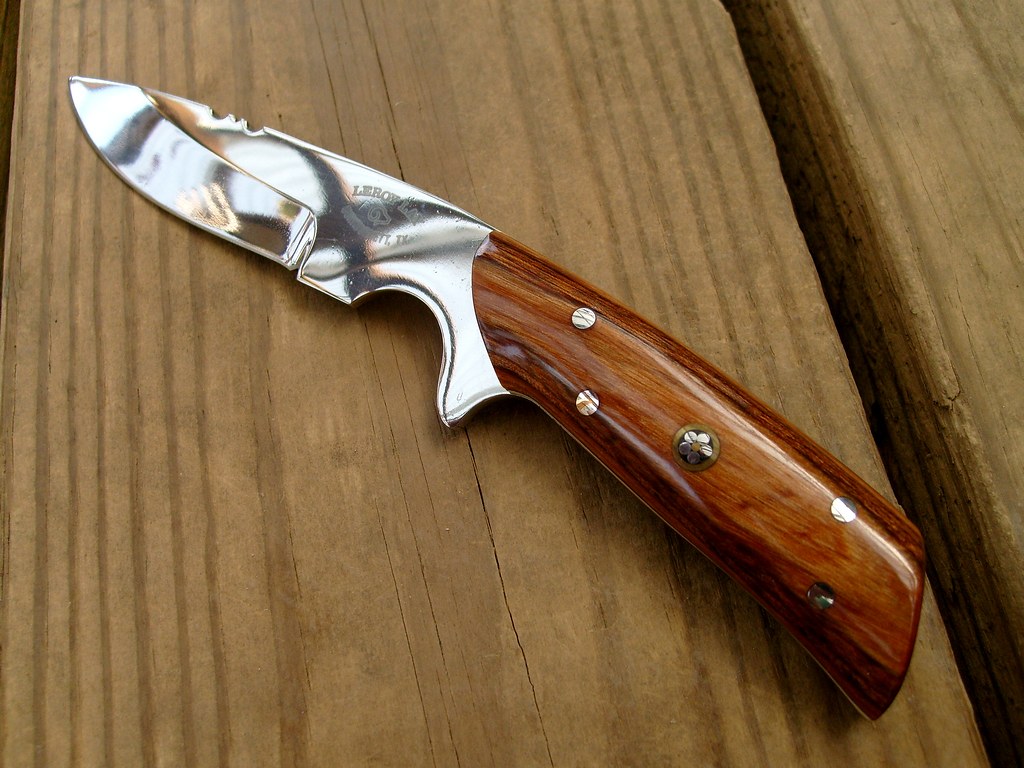
An open folding knife showing the blade and wooden scales. Public domain (CC0) via Openverse.
A knife that gets used regularly rarely rusts, because it gets handled, wiped and dried. The blades that develop pitting are the ones that went away dirty in autumn and came out in spring.
What actually causes corrosion
Rust needs moisture and oxygen. What accelerates it is anything that holds moisture against steel or lowers the barrier: salt, acids from food and blood, and residues left on the blade.
Blood is the one people underestimate. It is salty and mildly acidic, and a blade wiped on a trouser leg after field dressing still carries plenty of it.
Stainless steels resist this because chromium reacts with atmospheric oxygen to form a thin chromium-oxide film that adheres to the steel instead of flaking away like iron oxide. That passive film is only a few nanometres thick and re-forms on its own where oxygen is available — but it can be stripped by salt, acids and sustained high humidity, and pitting and crevice corrosion track closely with high relative humidity. “Stainless” means more resistant, not immune.
The cleaning that matters
Warm water and a little soap, then dry thoroughly. That is the whole procedure for most blades.
The part people skip is drying completely, including the pivot on a folder and the join where blade meets handle on a fixed blade. Those are exactly where moisture sits and where corrosion starts out of sight.
For folders, working the blade open and closed a few times after drying helps clear water from the pivot.
Oil, sparingly
A light film of oil on the blade is the standard protection. Food-safe mineral oil is a sensible default for anything that touches game or food.
More is not better. Heavy oil collects dust and grit, and on a folder it migrates into the mechanism and makes a paste with pocket lint.
Carbon steel benefits from a patina — the stable oxide layer that forms with use. A patina is protective. Red-orange pitting is not, and the difference is worth learning to recognize.
Where not to store a knife
Not in a leather sheath. Leather holds moisture and, depending on tanning, can carry residues that are actively unhelpful against steel.
Not in a sealed plastic bag or case with no ventilation, which traps whatever humidity was present.
Not in a vehicle. Trucks swing through large temperature ranges and condense moisture routinely — which is worth knowing, because the truck is exactly where most people keep a spare blade.
A dry drawer, blade lightly oiled, sheath stored separately, is unglamorous and works.
Dealing with rust that has already started
Surface rust — orange, powdery, sitting on top of the steel — comes off with the mildest thing that will move it. A cork or a wine bottle stopper with a little oil is the traditional approach and works better than it sounds. Fine synthetic abrasive pads, a brass brush, or a paste of baking soda and water all work on light corrosion without cutting the steel.
What matters is stopping short. Rust removal is metal removal, and aggressive abrasives will take the finish off the blade and round the edge while chasing a stain that was doing no harm. Dark, stable discoloration on carbon steel is patina, not rust, and removing it strips the protection it was providing.
Pitting is the line where this stops being cosmetic. A pit is a cavity in the steel, it holds moisture, and it will keep corroding from inside. Pitting along the edge means the apex is compromised and the blade needs grinding back past the damage.
Long storage, and folders specifically
A folder is harder to store than a fixed blade because the pivot holds moisture where you cannot see it or reach it. Before a long storage period, flush the pivot with a solvent or a light penetrating oil, work the action until it runs clean, and let it dry before applying fresh lubricant.
Blade steel and spring steel in a folder may differ, and the spring is the part that fails quietly. A liner lock or backspring that has corroded will feel normal right up until it does not hold, which is the failure with the worst consequences.
For a season or longer, a purpose-made vapor-corrosion-inhibitor paper or a silica gel pack in the storage box does more than any amount of oil. Both work by controlling the environment rather than by coating the steel, which is the more reliable of the two strategies.
Sources
- Thermal stability of the passive film formed on stainless steel (ScienceDirect)
- Study of the Corrosion Behavior of Stainless Steel in the Food Industry (Materials)
- Chromium content and corrosion resistance (ScienceDirect Topics)
This article was researched and drafted with the assistance of AI tools and reviewed, fact-checked and edited by Leonidas Clark before publication.