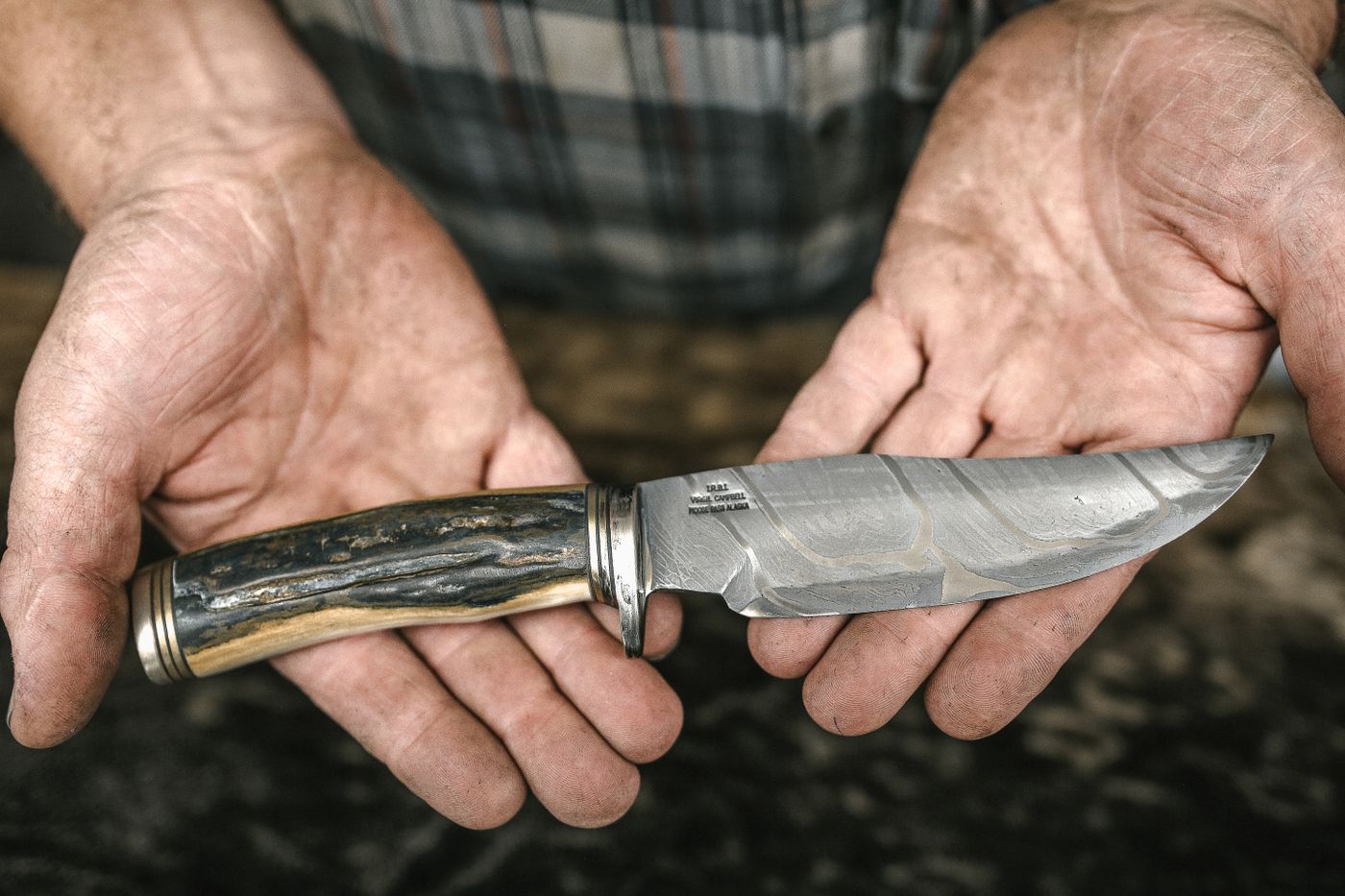
Two open hands holding a fixed-blade knife with a horn handle. Photo via Pexels.
Handle material gets discussed in terms of looks and durability. The property that matters most in use is how the handle behaves when your hands are wet, cold, greasy or gloved — which is when most outdoor knife work actually happens.
Grip is texture plus shape
Two separate things are doing the work.
Texture is friction — the surface resisting slip. Shape is mechanical retention: swells, finger guards and palm curves that stop the hand traveling forward even when friction fails.
Shape matters more. A textured handle with no guard still lets a wet hand slide onto the blade under a hard thrust; a smooth handle with a proper guard does not. That failure is the mechanism behind a large share of the 8.25 million knife injuries treated in US emergency departments between 1990 and 2008.
This is why a finger guard or a pronounced choil is a safety feature rather than an aesthetic one.
How common materials behave
Micarta and G10 are laminates. Both get grippier as they get wet, which is unusual and useful. Micarta develops a worn-in feel over years; G10 is harder and holds an aggressive texture longer.
Rubberized and thermoplastic handles grip well and are comfortable in the hand, but can get slick with fat and blood specifically, which is not the same as water.
Wood is warm to hold in the cold and beautiful, and its grip depends heavily on finish. A glossy sealed wood handle is slippery wet; an oiled, open-grain one is not.
Bone, antler and polished metal look superb and are the worst performers wet. That is a fair trade for a knife that is mostly admired, and a poor one for a knife that works.
The cold problem
Cold does two things. It reduces sensation, so you grip harder than you need to and tire faster. And it makes some polymers stiffen and some metals painful to touch.
A metal-handled knife in genuine cold is unpleasant, and with bare skin on very cold metal there is a real adhesion risk. Wood and laminates are far more forgiving.
Test it the way you will use it
The useful test is not holding a knife in a shop. It is holding it with a wet glove, or with cooking oil on your hand, and seeing whether the shape stops your hand moving.
If the only thing keeping your hand off the edge is friction, the handle is not finished.
Wood, bone and antler
Natural materials are warm in the hand and dimensionally unstable. Wood moves with humidity, which is why stabilized wood — resin-impregnated under vacuum — is now standard on knives meant for wet work. Bone and antler are hard, grippier when wet than polished wood, and prone to cracking if a knife is dried too fast near a fire.
Rubber and thermoplastics
Rubberized handles grip superbly and degrade predictably. Ultraviolet exposure, solvents and long-term compression all break them down, and a rubber overmould that has gone tacky is at the end of its life. Hard thermoplastics last far longer and give up some grip in exchange.
Gloves change everything
Most handle assessment happens bare-handed in a shop. In use, a cold-weather knife is held in gloves, which mutes texture almost entirely and leaves shape doing all the work. That is the strongest argument for a pronounced guard or choil, and it is also why a handle that feels aggressive bare can feel featureless gloved.
Since cutting force is governed by edge geometry, anything the handle does to reduce control translates directly into needing more force and having less of it.
Sources
- The Epidemiology of Hand and Finger Lacerations in United States Emergency Departments (PubMed)
- A Comprehensive Understanding of Knife Cutting: Effects of Hardness, Blade Angle and Micro-Geometry of Blade Edge (PMC)
This article was researched and drafted with the assistance of AI tools and reviewed, fact-checked and edited by Leonidas Clark before publication.