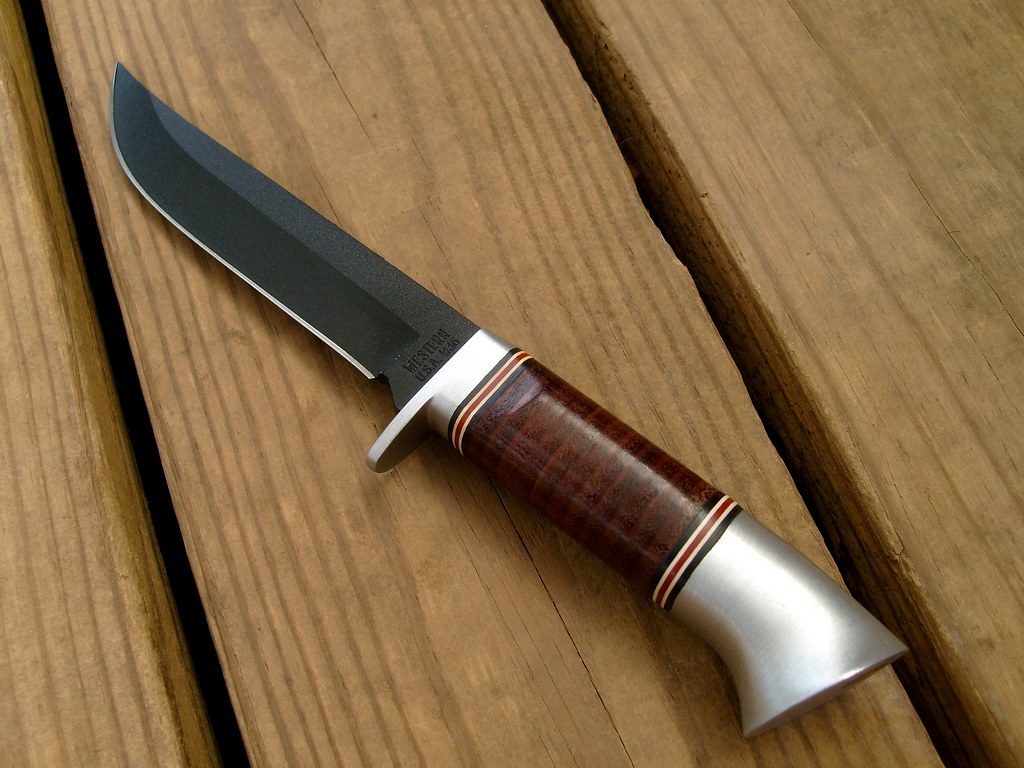
A clip-point fixed-blade knife resting on wooden boards. Public domain (CC0) via Openverse.
A gut hook is a small, sharpened crescent cut into the spine of a blade near the tip. Its purpose is narrow: opening the abdominal cavity without puncturing what is inside.
What it does well
Field dressing carries a specific risk. A blade point driven through the hide can also go through the stomach or intestine, and a punctured gut contaminates meat quickly.
A gut hook removes the point from that equation. You make a small starting incision, slip the hook under the hide, and pull. The hook cuts hide from underneath, upward, with the blade tip pointing away from the cavity.
For that one operation, it is genuinely better than a straight edge, and it is faster for someone still building confidence in the technique.
What it costs
The hook occupies spine real estate near the tip — exactly where you want a clean spine for other tasks.
It makes the knife awkward to use for detail work near the point. It interferes with a squared spine for ferro-rod striking. It catches on sheath mouths and on clothing — and a blade that snags on the draw is a live hazard, given that knives account for roughly 30 percent of hand and finger lacerations treated in US emergency departments.
And it is genuinely difficult to sharpen. The inside curve of a hook needs a round file, a tapered ceramic rod, or a folded piece of abrasive. Most people never sharpen it, which means the feature they bought the knife for gets progressively worse.
The skill argument
An experienced hand opens a cavity with a straight blade by using two fingers as a guide — blade edge up, fingers ahead of the point, working by feel. Done that way, the risk the gut hook solves largely goes away.
That is not a reason to dismiss the hook. It is a reason to be honest about what you are buying: a tool that substitutes for a technique.
The practical middle ground
Many people who hunt regularly end up carrying a small dedicated hook — a standalone tool or a replaceable-blade design — rather than a knife with a hook ground into it. That keeps the main blade clean and puts the hook where it can be replaced rather than sharpened.
If you are choosing one knife and you process a few animals a year, a gut hook is a reasonable convenience. If the same knife is also your camp and wood knife, the compromise starts costing more than it returns.
Sharpening one, if you have one
The inside curve of a gut hook cannot be reached by a flat stone, which is why most of them are dull. The tools that work are a round ceramic rod of small diameter, a chainsaw file, or a strip of wet-and-dry abrasive wrapped around a dowel or a drill bit.
The technique is to match the existing bevel angle and work only on the inside of the curve, drawing the rod through the hook in one direction. A few passes is usually enough, because the hook does very little work compared with the main edge. Finishing with a strop or a pass on leather knocks off the burr that would otherwise roll over on first use.
The tip of the hook wears first and matters most. If the point of the crescent is rounded, the hook will skate on hide instead of starting a cut, and no amount of work on the curve behind it will fix that.
Sheath fit is the other half of the decision
A gut hook changes how a knife enters and leaves a sheath. The hook catches on the welt, on the mouth of a leather sheath as it softens, and on the retention strap. A sheath cut for a plain spine will usually accept a gut-hook blade going in and fight it coming out.
That is not a minor annoyance. A knife that requires a tug to draw arrives free suddenly, with the hand already moving, which is the sequence behind a large share of self-inflicted knife injuries. If you carry a gut-hook blade, carry it in a sheath made for that blade.
Who it genuinely suits
The honest summary is that a gut hook rewards a specific user: someone who dresses a handful of animals a year, wants the operation to be lower risk while their technique is still developing, and carries a separate knife for camp work.
It penalizes the person carrying one knife for everything, and it penalizes anyone who will not maintain it. Neither of those is a criticism of the design — it is a narrow tool, and the mistake is asking a narrow tool to be a general one.
Sources
- A Comprehensive Understanding of Knife Cutting: Effects of Hardness, Blade Angle and Micro-Geometry of Blade Edge (PMC)
- The Epidemiology of Hand and Finger Lacerations in United States Emergency Departments (PubMed)
- Knife-related injuries treated in United States emergency departments, 1990–2008 (PubMed)
This article was researched and drafted with the assistance of AI tools and reviewed, fact-checked and edited by Leonidas Clark before publication.