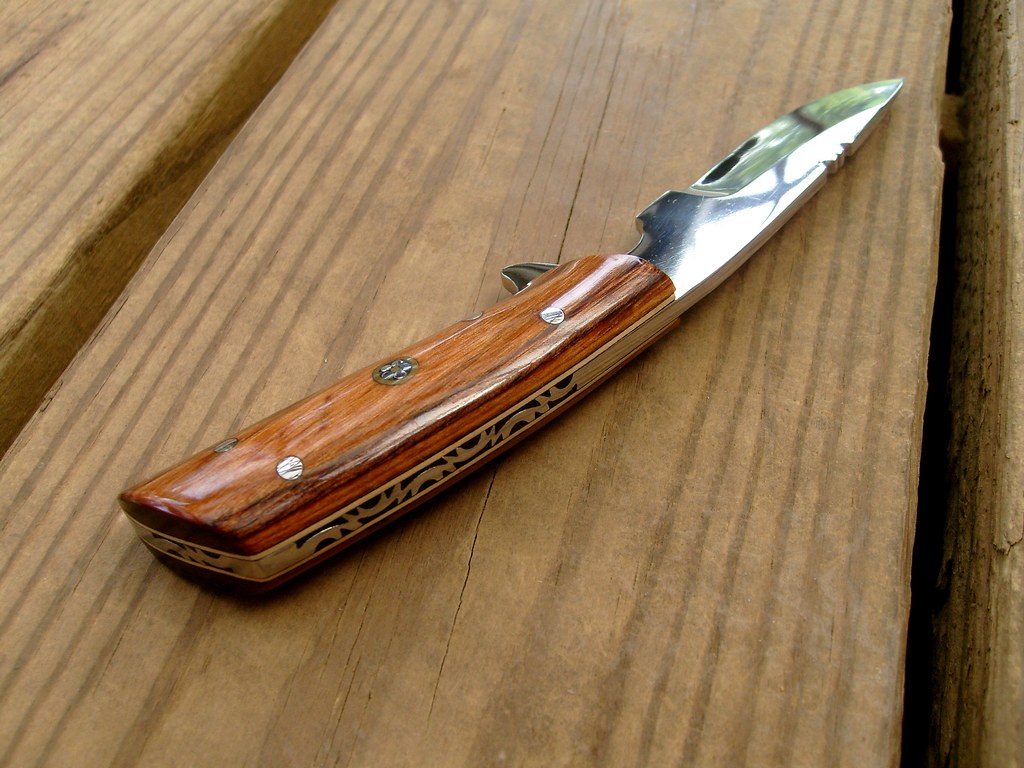
A folding knife with a wooden handle open on a wooden surface. Public domain (CC0) via Openverse.
A folding knife is a blade attached to a hinge, held open by a mechanism. That mechanism is the whole safety story, and each common type fails in a characteristic way. It is worth knowing which one you carry: knives account for roughly 30 percent of hand and finger lacerations treated in US emergency departments, and fingers and thumbs are injured in about two thirds of cases.
This is not an argument for one lock over another. It is an argument for knowing which one is in your pocket.
Slipjoint: no lock at all
Traditional pocket knives often have no lock — a spring holds the blade open by tension. Pressure on the spine folds it.
This is not a defect; it is a design, and in some jurisdictions a non-locking blade is treated differently in law than a locking one. What it means practically is that a slipjoint should never be used in a way that loads the spine.
Liner and frame locks
A liner lock uses a leaf of the internal liner that springs across behind the blade tang. A frame lock does the same with a thicker slab of the handle itself.
Both fail the same way: the lock bar is pushed out of engagement. That can happen from a hard impact, from a poor lock-up geometry that lets the bar sit too close to the edge of the tang, or — most commonly in real use — from the user’s own grip pressing the bar sideways.
Frame locks are generally stronger because the engaging piece is thicker. Neither likes lateral force.
Lockback
A lockback uses a spine-mounted bar that drops into a notch in the blade tang. The release is usually a cut-out midway along the handle.
Failure comes from wear in the notch or from grit preventing full seating. A lockback that has developed vertical play at the blade is telling you something.
Its practical advantage is that grip pressure does not disengage it, because the release is not under your fingers in a normal hold.
Axis-style and button locks
These use a spring-loaded pin or bar that moves into a cut in the tang. They are generally strong, ambidextrous, and let you close the knife without putting fingers in the blade path — a genuine safety benefit.
They have more small parts. Springs fatigue and break, and the failure is usually sudden rather than gradual.
What to actually check
Open the knife and, carefully and away from your fingers, press the spine against a table. Any movement is worth understanding.
Check for blade play side to side and up and down. Check that the lock engages fully rather than at the very edge of the tang. Check that grit and pocket lint are not packing the mechanism — the most common real-world cause of a lock behaving oddly is that it is filthy.
And regardless of lock type: a folder is a compromise for portability. Anything involving impact or prying belongs on a fixed blade.
Keeping a lock working
Nearly every lock failure that is not a design limit is a maintenance failure, and the cause is usually grit rather than wear.
Dust, sand and dried blood in the lock interface prevent the bar or pin from seating fully, which leaves a fraction of the engagement doing all the work. The fix is flushing rather than wiping — a solvent or hot water through the pivot and lock area, worked until the action runs clean, then dried and lightly lubricated.
On a liner or frame lock, the engagement position tells you about wear. A new knife typically locks up early, with the bar contacting a small portion of the tang. Over years it travels across, and a lock bar that has reached the far side of the tang is near the end of its adjustment. That is a slow process measured in years of use, not a reason to worry about a knife that has moved slightly.
Sticky lockup on a frame lock is usually the opposite problem — a bar binding against the tang rather than releasing cleanly, which a small amount of lubricant on the contact face resolves.
Where a fixed blade is the honest answer
Every lock is a mechanism standing in for a solid piece of steel, and for some work the substitution is not worth making.
Batoning, heavy prying, chopping, and anything applying force toward the closed position are the cases where a folder is being asked to do the one thing its geometry is worst at. Field dressing with cold, wet hands belongs on that list too, since a hand slipping forward onto an unlocked or partly seated blade is the sequence behind a large share of serious knife injuries.
A folder is a knife you actually have with you, which is worth a great deal. The argument is not that folders are unsafe — it is that a lock is a convenience feature, not a substitute for a tang that runs the length of the handle.
Sources
- The Epidemiology of Hand and Finger Lacerations in United States Emergency Departments (PubMed)
- Knife-related injuries treated in United States emergency departments, 1990–2008 (PubMed)
This article was researched and drafted with the assistance of AI tools and reviewed, fact-checked and edited by Leonidas Clark before publication.