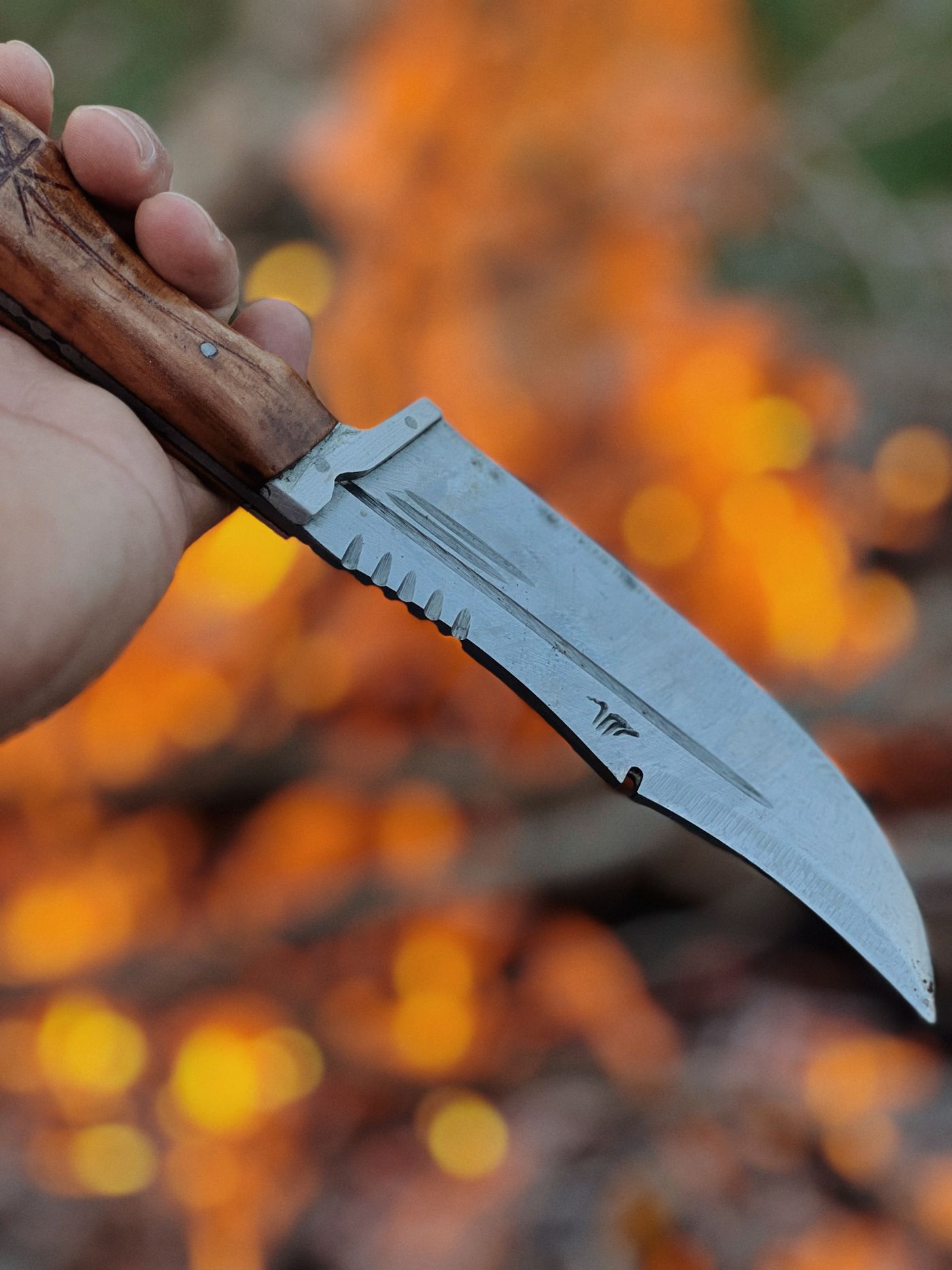
A person holding a fixed-blade knife beside a campfire. Photo via Pexels.
“You can’t carry a knife in a national park” is one of the more durable pieces of outdoor folklore. It comes from a real regulation — but from misreading which definition that regulation runs on.
Here is what the rule actually says.
The rule people are thinking of
36 CFR § 2.4 is titled “Weapons, traps and nets.” Subject to exceptions, it prohibits possessing, carrying or using a weapon, trap or net in National Park System units.
Read alone, that sounds broad. The exceptions it lists are narrow — places and times where taking wildlife or fish is authorized, designated target practice facilities, and inside a residential dwelling. It also allows unloaded weapons to be carried in temporary lodging or a vehicle when packed, cased, or otherwise rendered not readily usable, and prohibits a loaded weapon in a motor vehicle or vessel.
Firearms are handled separately at the top of the section: the regulation cannot be enforced to prohibit possession by someone not otherwise barred by law, provided possession complies with the law of the state the park unit sits in.
The definition that changes everything
The operative word is “weapon,” and it is defined not in § 2.4 but in 36 CFR § 1.4:
Weapon means a firearm, compressed gas or spring-powered pistol or rifle, bow and arrow, crossbow, blowgun, speargun, hand-thrown spear, slingshot, irritant gas device, explosive device, or any other implement designed to discharge missiles, and includes a weapon the possession of which is prohibited under the laws of the State…
Read the list. Every item either discharges a projectile or is thrown as one, and the catch-all closes on “any other implement designed to discharge missiles.”
An ordinary pocket knife, sheath knife or camp axe is not on that list and does not discharge missiles. That is why the sweeping reading of § 2.4 does not do what people assume it does.
What this does not mean
It does not mean knives are unregulated on federal land, and it is worth being careful here rather than confident.
Individual park units issue their own regulations under 36 CFR part 7, and superintendents can impose restrictions on specific areas. Alaska units operate under part 13. Those can and do differ from the general rule.
The definition also expressly incorporates state law for prohibited weapons, so a knife unlawful under the law of the state a park sits in does not become lawful by being carried inside the park boundary.
Separately, federal buildings inside parks — visitor centers, administrative offices — are governed by rules about federal facilities rather than by § 2.4, and those are a different question again.
The practical version
A knife you carry as a tool, for camp chores and food, is not what § 2.4 was written to address, and it is not covered by the definition § 2.4 relies on.
Before a trip, the two things worth checking are the specific park’s own regulations and the law of the state it is in. Both are more likely to matter than the general federal rule.
And as always with this category: this is general information, not legal advice, and a question with real consequences deserves a lawyer rather than an article.
Where a knife can still cause a problem in a park
Reading the definition settles the general question and leaves a few specific ones open, and those are the ones worth knowing before a trip.
The state-law clause is the largest. Because the definition sweeps in any weapon prohibited under the law of the state, a knife that is unlawful in that state is unlawful in the park within it — automatic knives, certain blade lengths and particular designs are restricted in some states, and the park boundary does not change that.
Federal buildings inside a park sit under 18 U.S.C. § 930, which reaches “dangerous weapons” defined far more broadly than § 1.4 does, with an express exclusion only for pocket knives with blades under two and a half inches. A visitor center is therefore a different legal environment from the trail outside it.
Unit-specific regulations under 36 CFR part 7 and superintendent’s compendia can add restrictions for particular areas, and a compendium is where a park records closures and conditions that do not appear in the national regulations. It is published on the park’s own website.
Use is regulated even where possession is not
The other half of the answer is that what you do with a knife is governed separately from whether you may carry one.
Cutting, carving or damaging vegetation is prohibited in park units, as is defacing rock or structures. Collecting is generally prohibited. None of those rules mention knives, and all of them are reached by using one.
So the accurate framing is that an ordinary knife carried as a tool is not what § 2.4 addresses, while the ordinary rules about not damaging the resource apply exactly as they do to anyone else. The folklore gets the conclusion wrong and the instinct roughly right — a park is a place where what you cut matters.
This article was researched and drafted with the assistance of AI tools and reviewed, fact-checked and edited by Leonidas Clark before publication. It is general information, not legal advice. Individual parks carry their own regulations; check the unit you are visiting.